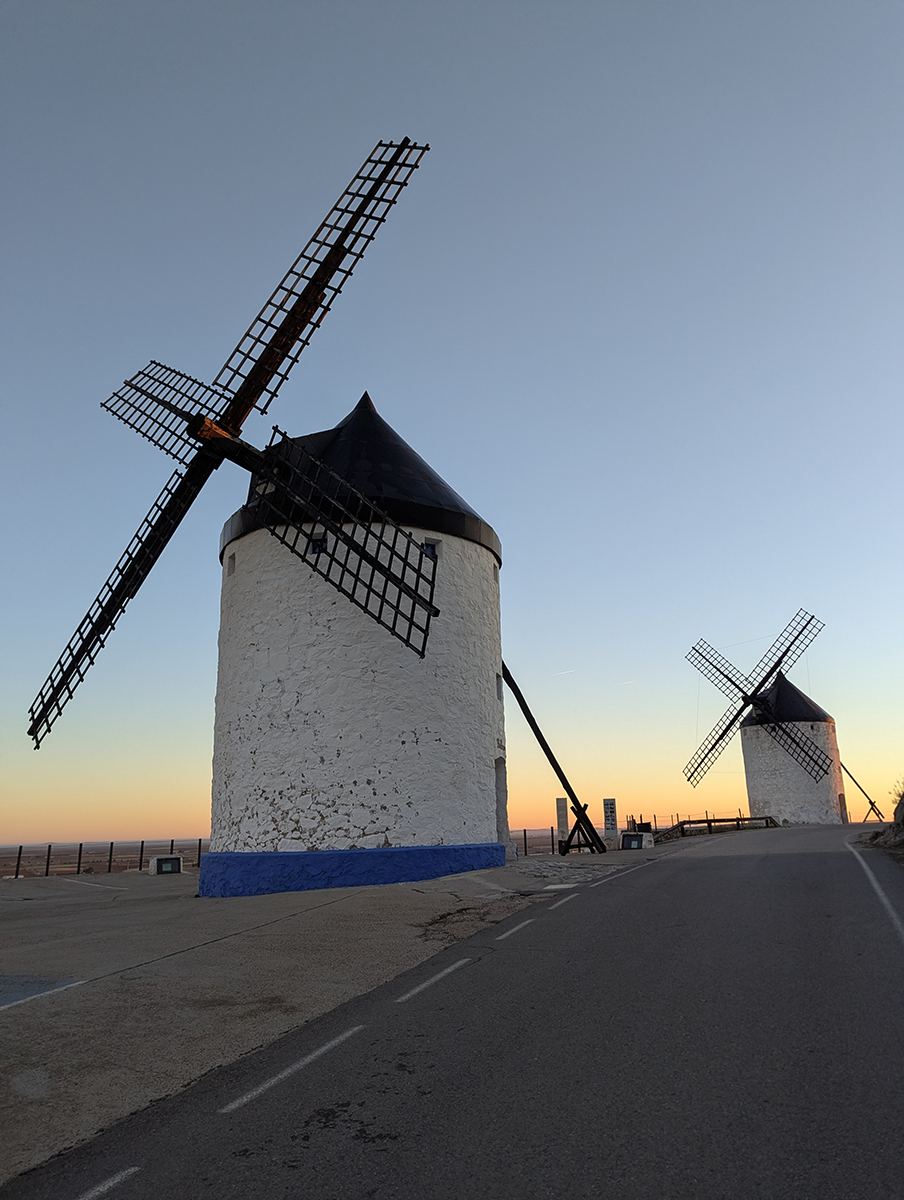
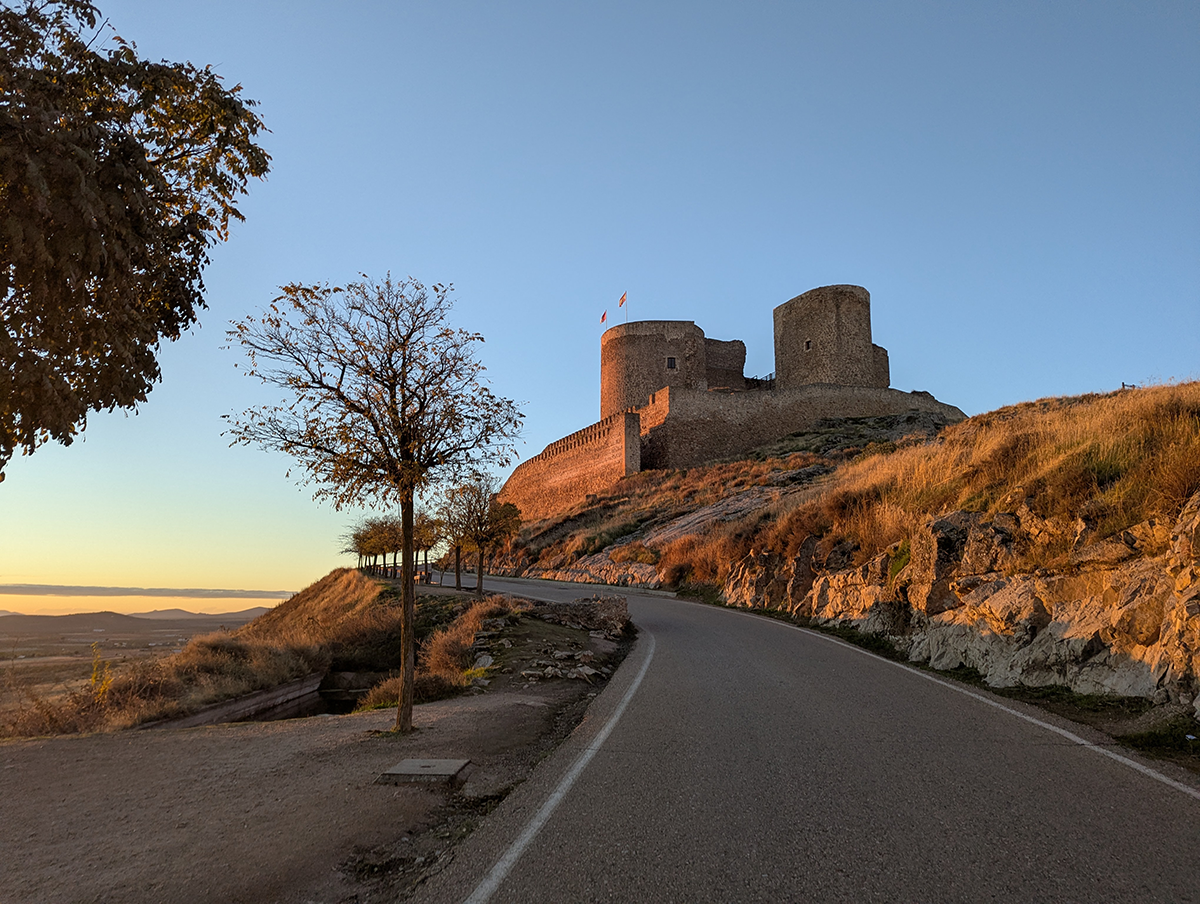
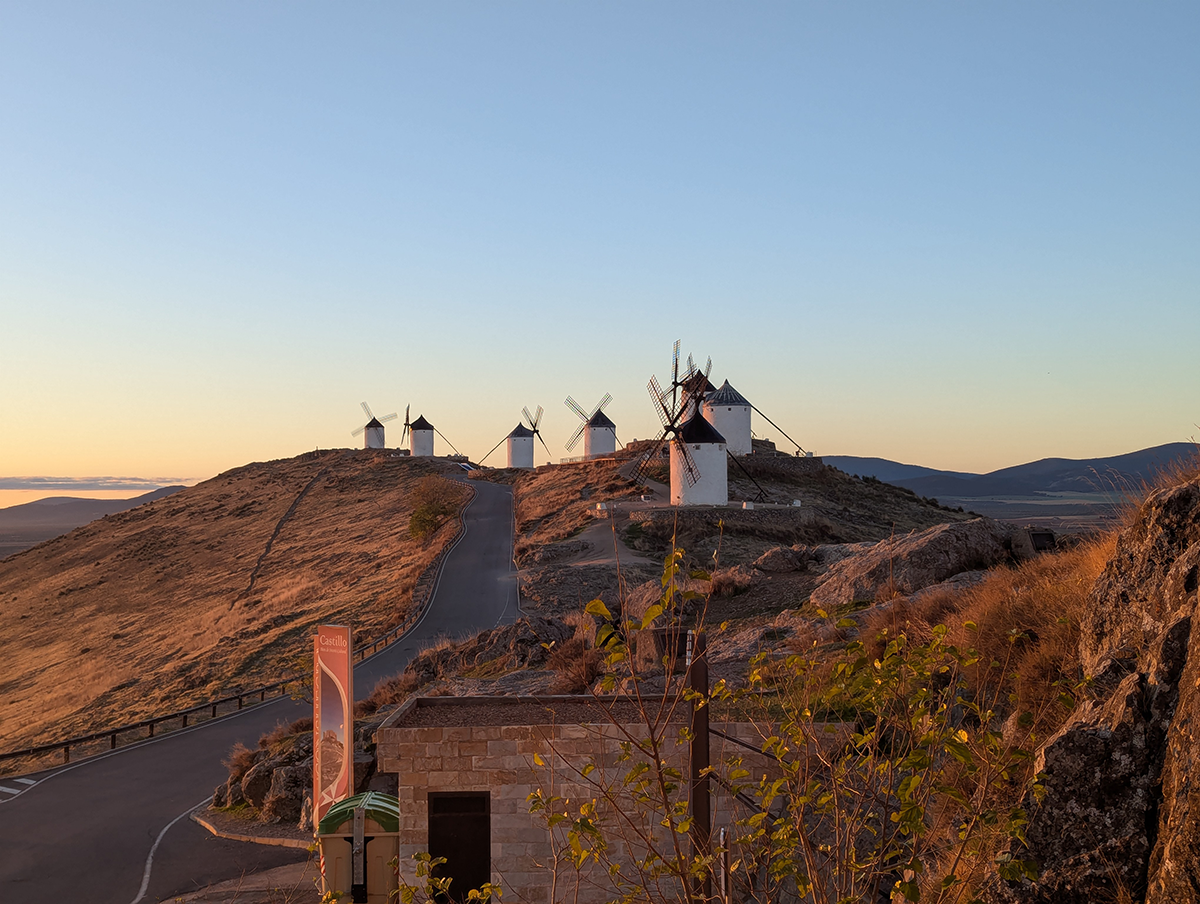
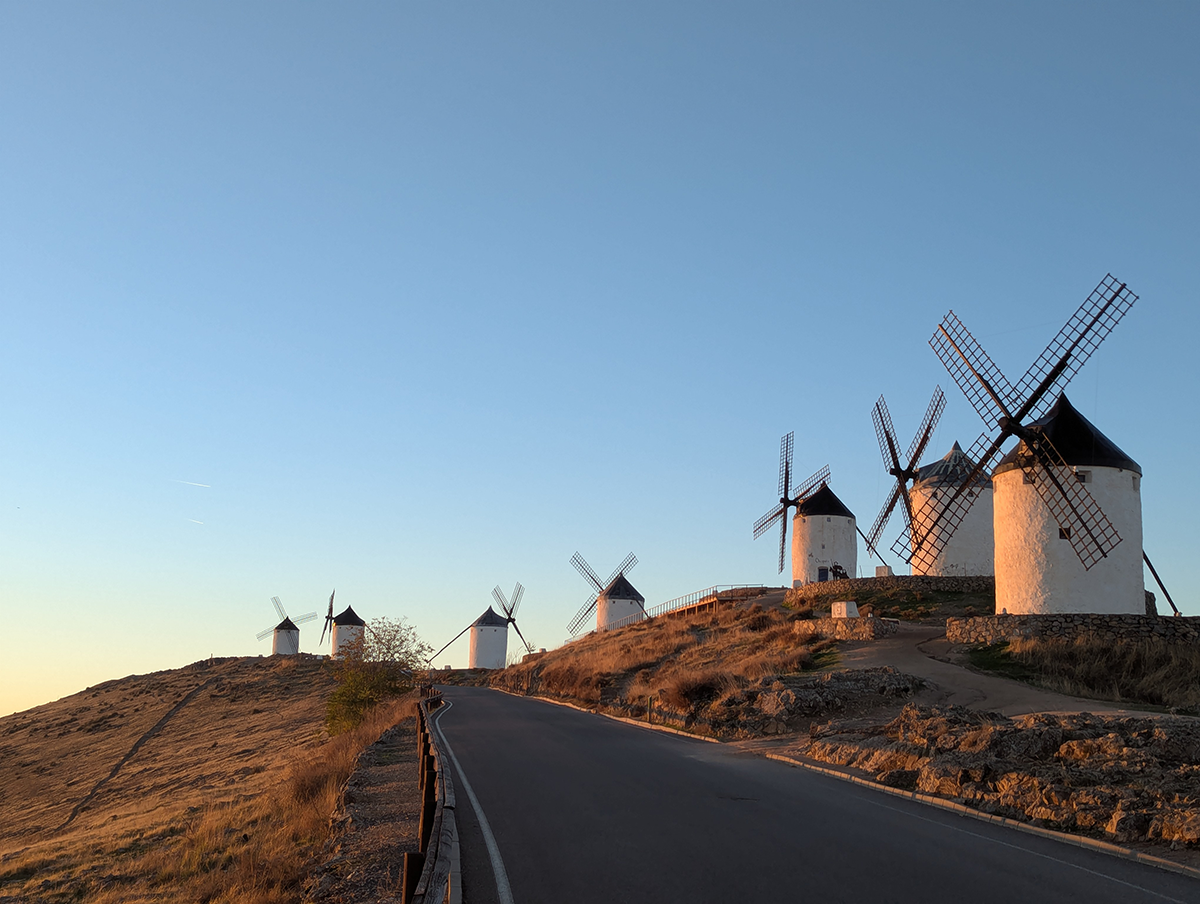
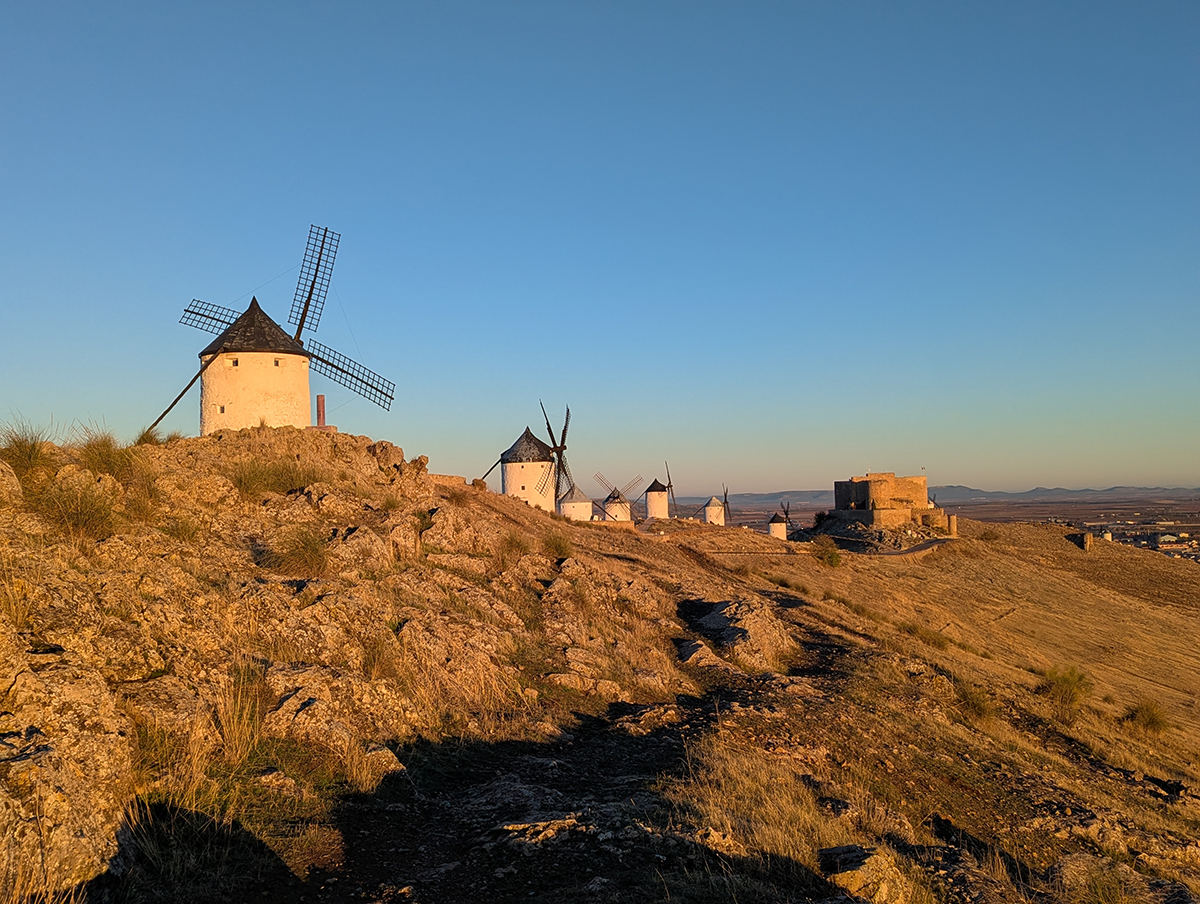
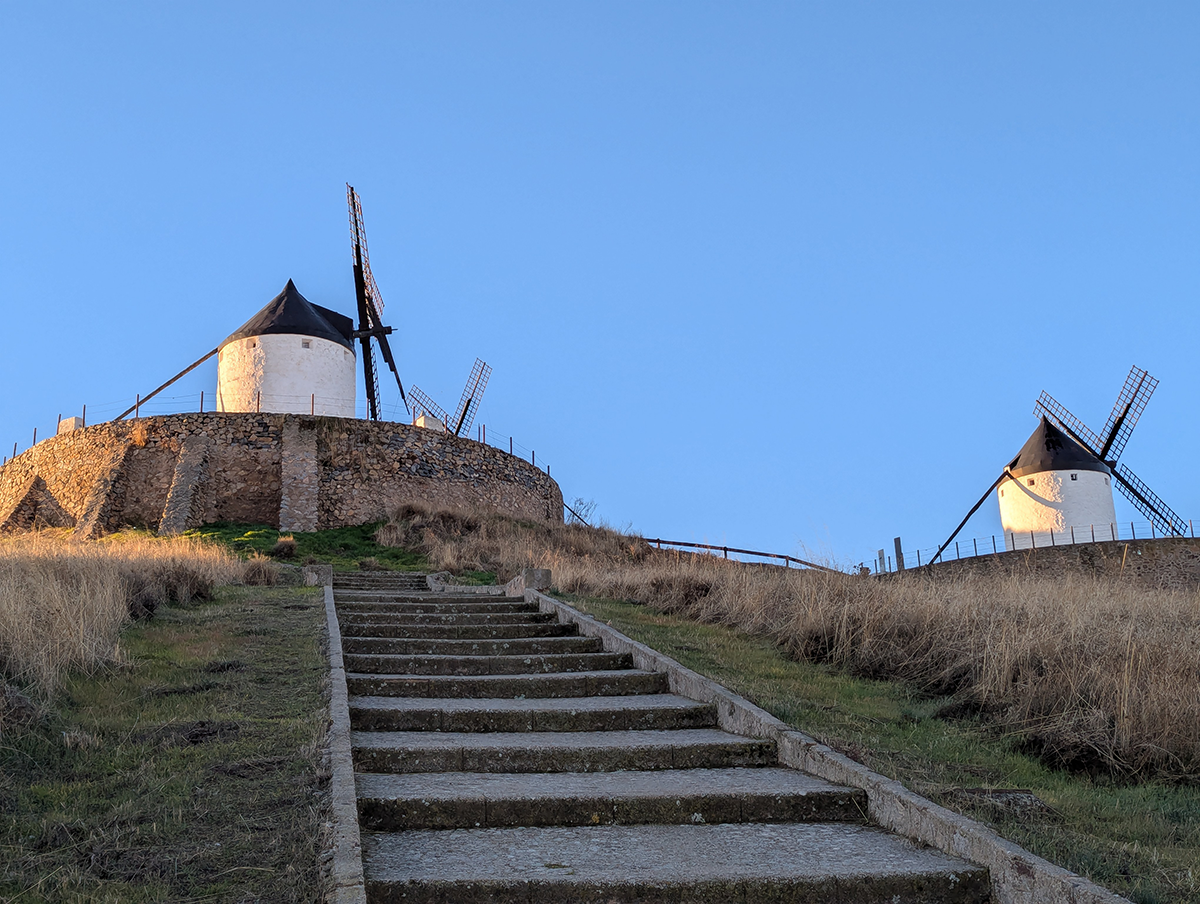
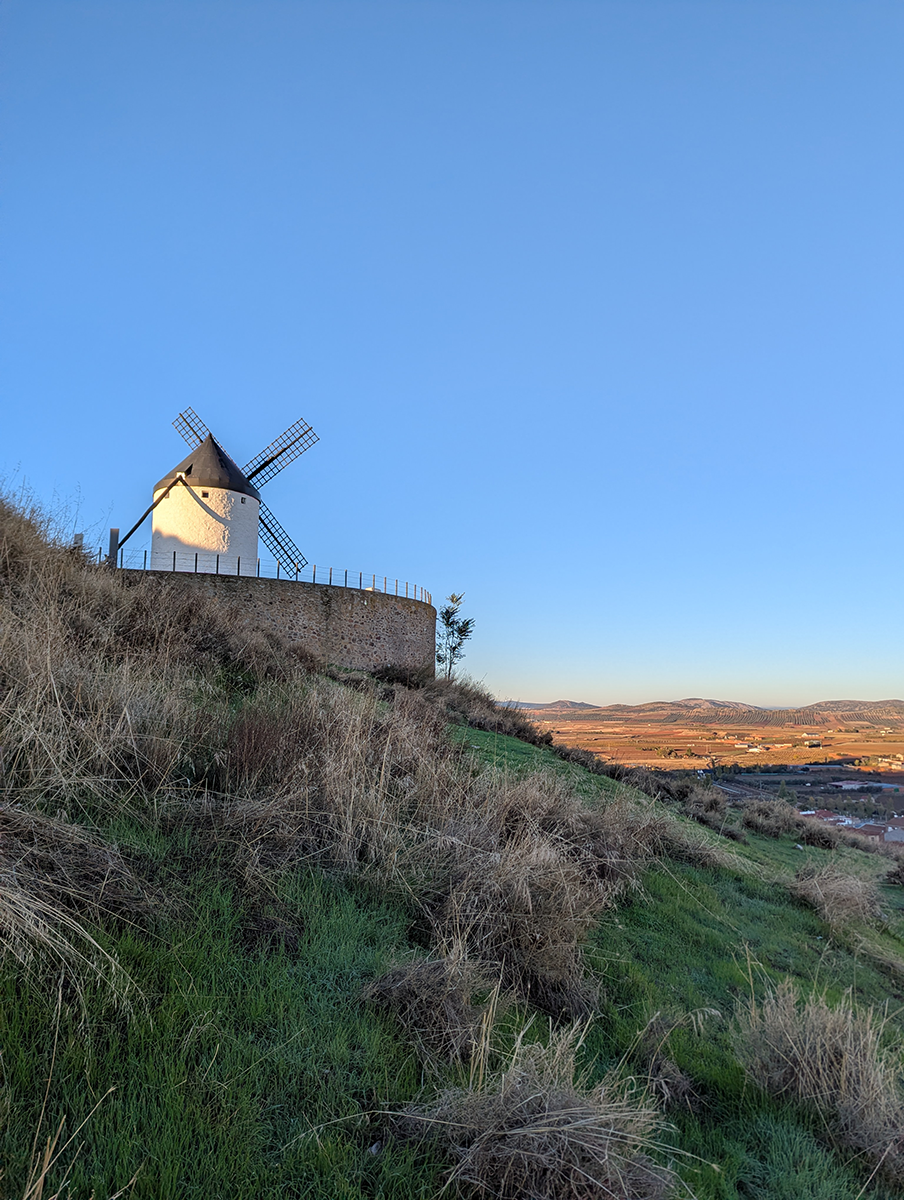
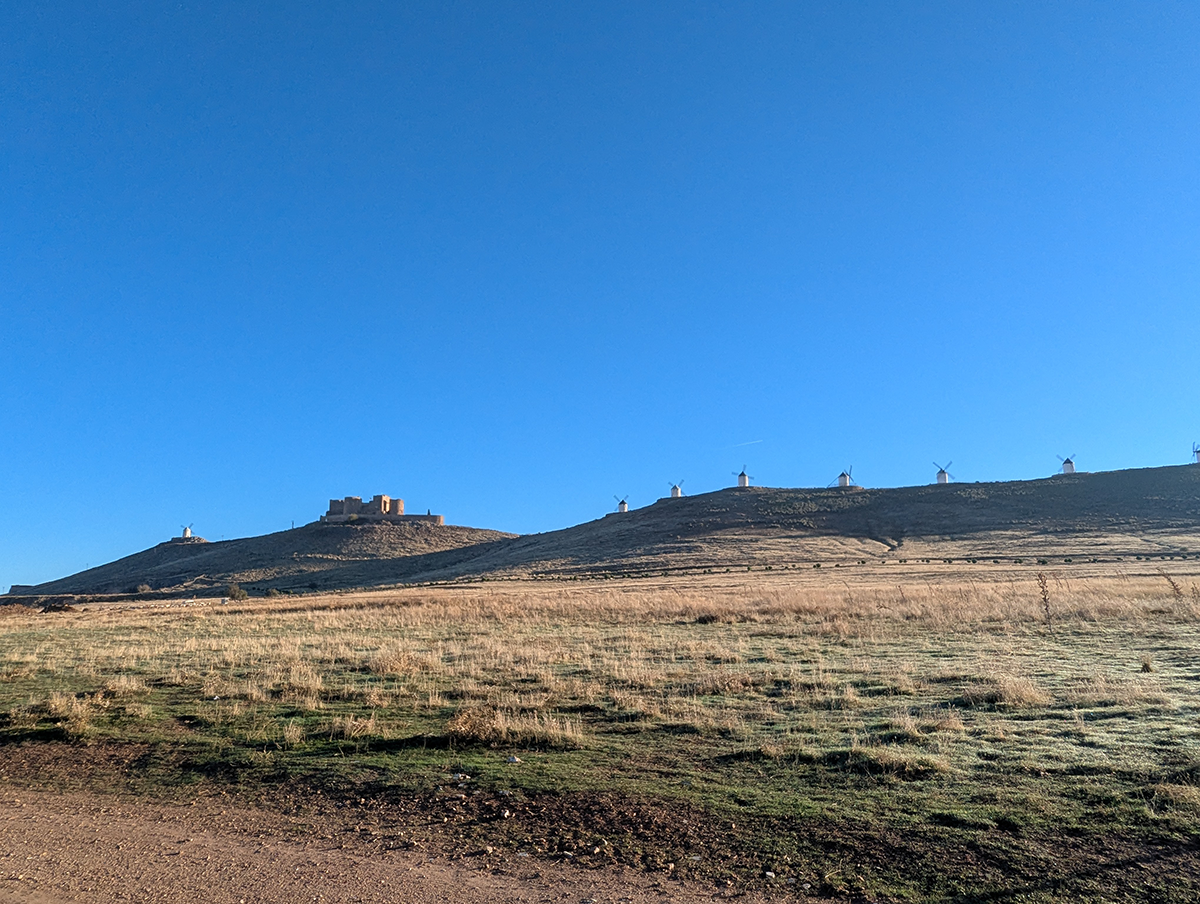
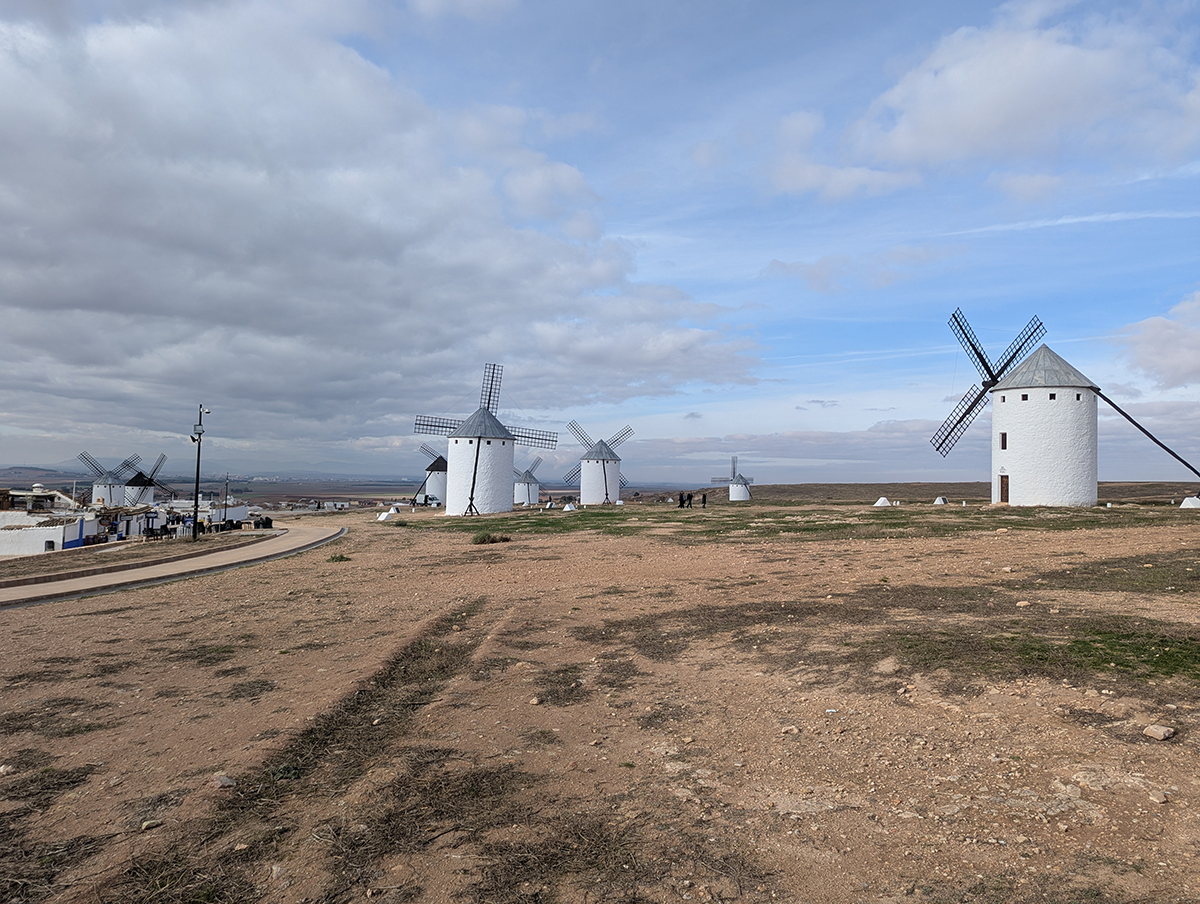
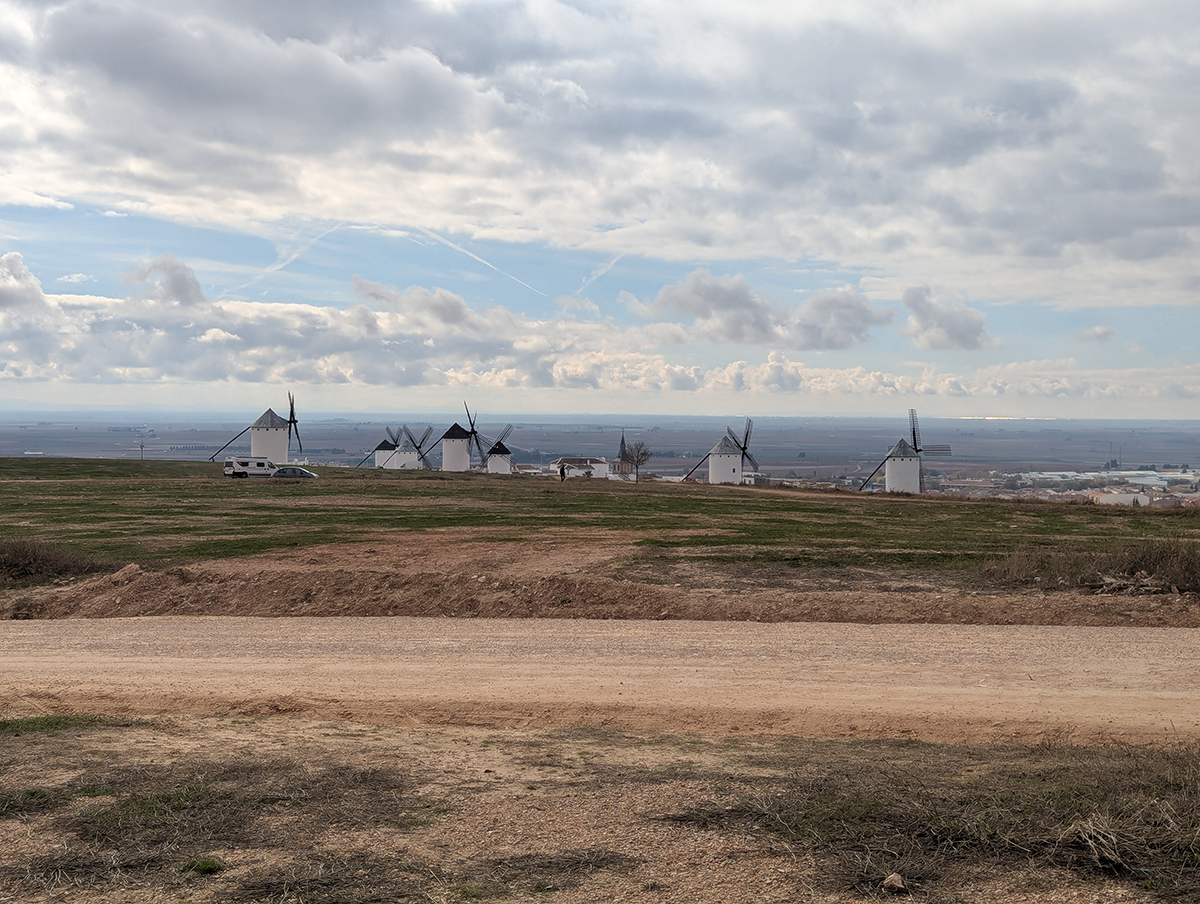
On a chilly Monday morning in Consuegra, Spain, I got up before the sun and ran up a ridge to look at 12 windmills and a castle. Later that morning, Marion and I both climbed the hill, looked at the windmills again, and toured the castle. We ended up taking lots of photos.
I’ve been asked by more than one person, “Why Consuegra?” What on earth prompted us to visit this tiny town south of Madrid?
Land of La Mancha
When we were planning our trip to Spain, Marion and I knew we wanted to explore the countryside between Madrid and Valencia. It didn’t take much digging to discover the region is called “Castile-La Mancha.” Naturally, this evoked the stage musical, “Man of La Mancha,” which has been one of my favorites since I was a teenager. Even if you haven’t seen it, you’ve probably heard the song, “The Impossible Dream,” and maybe even “Dulcinea,” “I Really Like Him,” or “Golden Helmet of Mambrino.”
Of course, “Man of La Mancha” is based on “The Ingenious Gentleman Don Quixote of La Mancha” by Miguel de Cervantes. It’s considered to be the very first modern novel. Seriously—the very first. It’s also one of the greatest novels ever written, having been translated into more languages than just about any other work of fiction. Published in 1605 and 1615 (in two volumes), it tells the story of a Spanish man who reads medieval romances until his brain comes unhinged. Riding an old cart horse, he travels the Spanish countryside with his “squire” Sancho Panza, performing comic deeds of chivalry.
At one point in the story, Quixote encounters an army of “giants” on a hill and charges them with his lance. They’re not giants, obviously, but windmills. That’s where we get the expression “tilting at windmills.”

Anyway, the windmills of Consuegra are believed by many to be the very ones that inspired Cervantes to write that episode of his story. (See below for more on this.) Some were built before Shakespeare was born, and they were still grinding grain well into the 20th century. They’re in pretty good shape, considering how old they are.
I guess the same could be said about me.
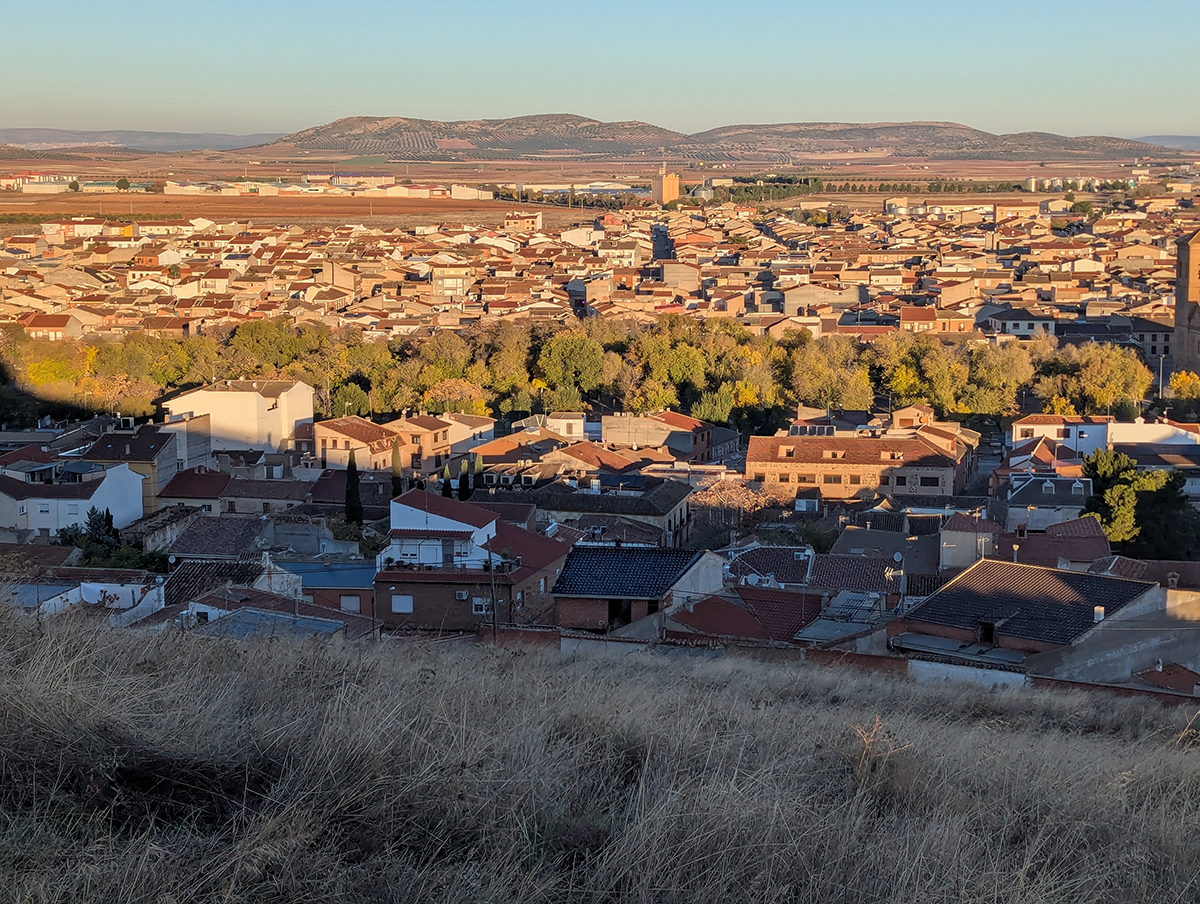
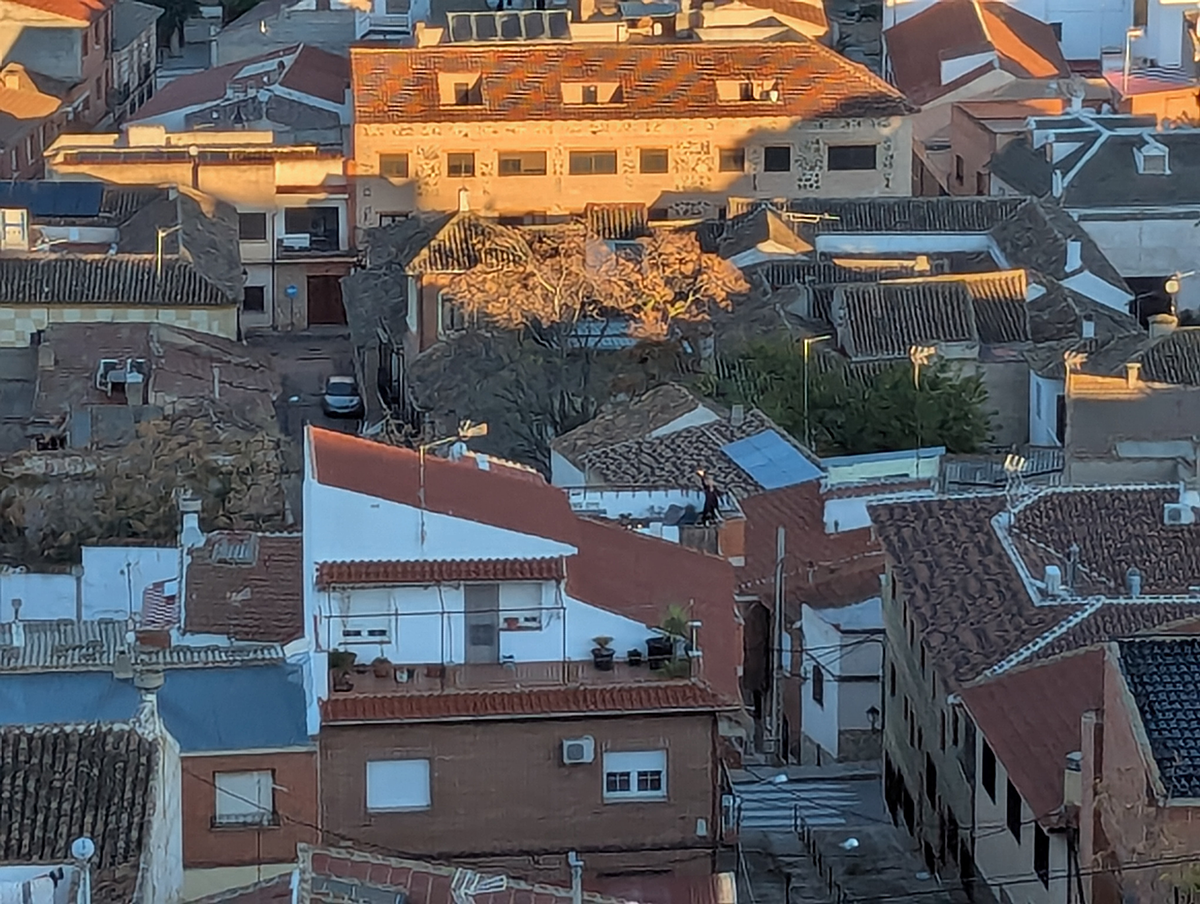
The sleepy little town is fiercely proud of its windmills and their history. In fact, the keychain for the AirBNB was a miniature shaving basin (IYKYK). When we arrived in Consuegra, we were thrilled to find we could see the windmills from the rooftop of our apartment. We extended our stay in the area for an extra day so we could explore the windmills, the castle, and the town.
Running Around the Cerro Calderico

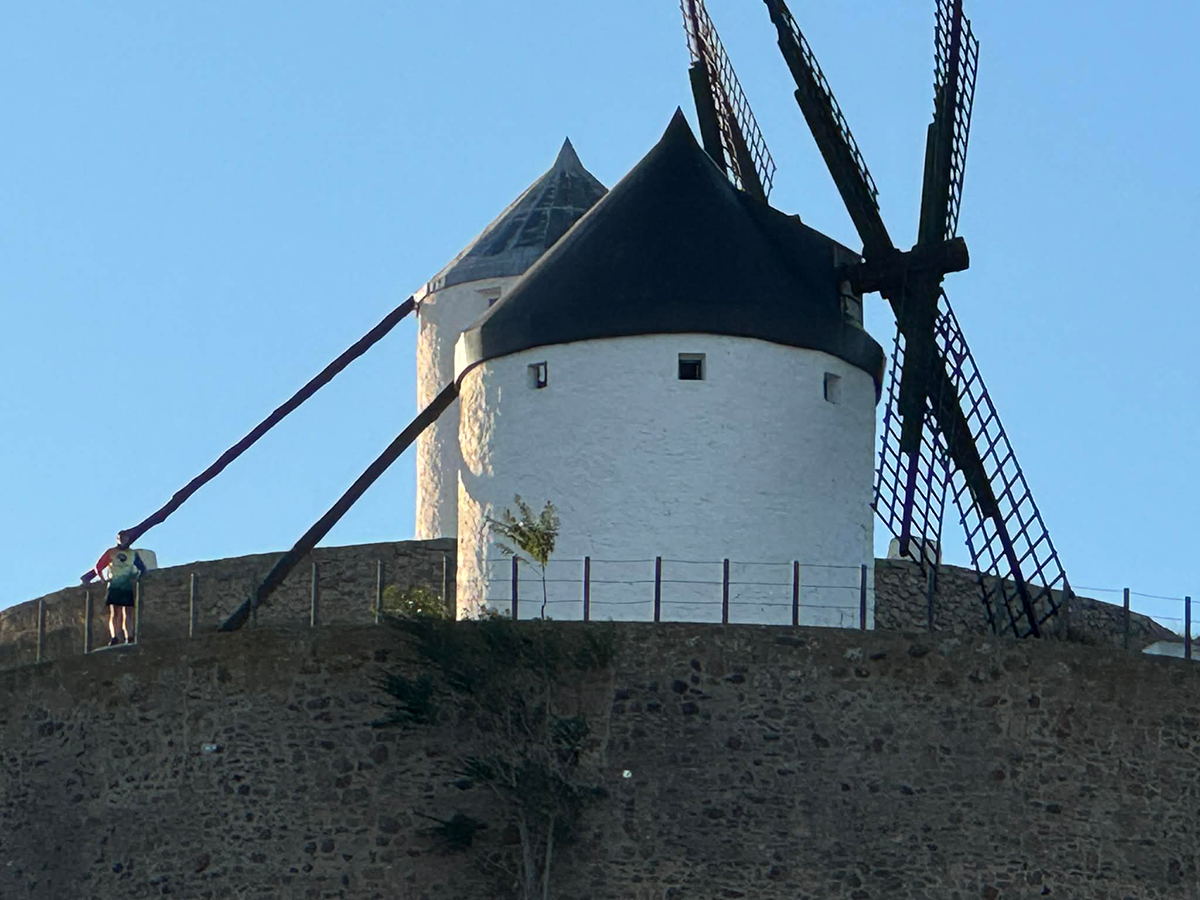
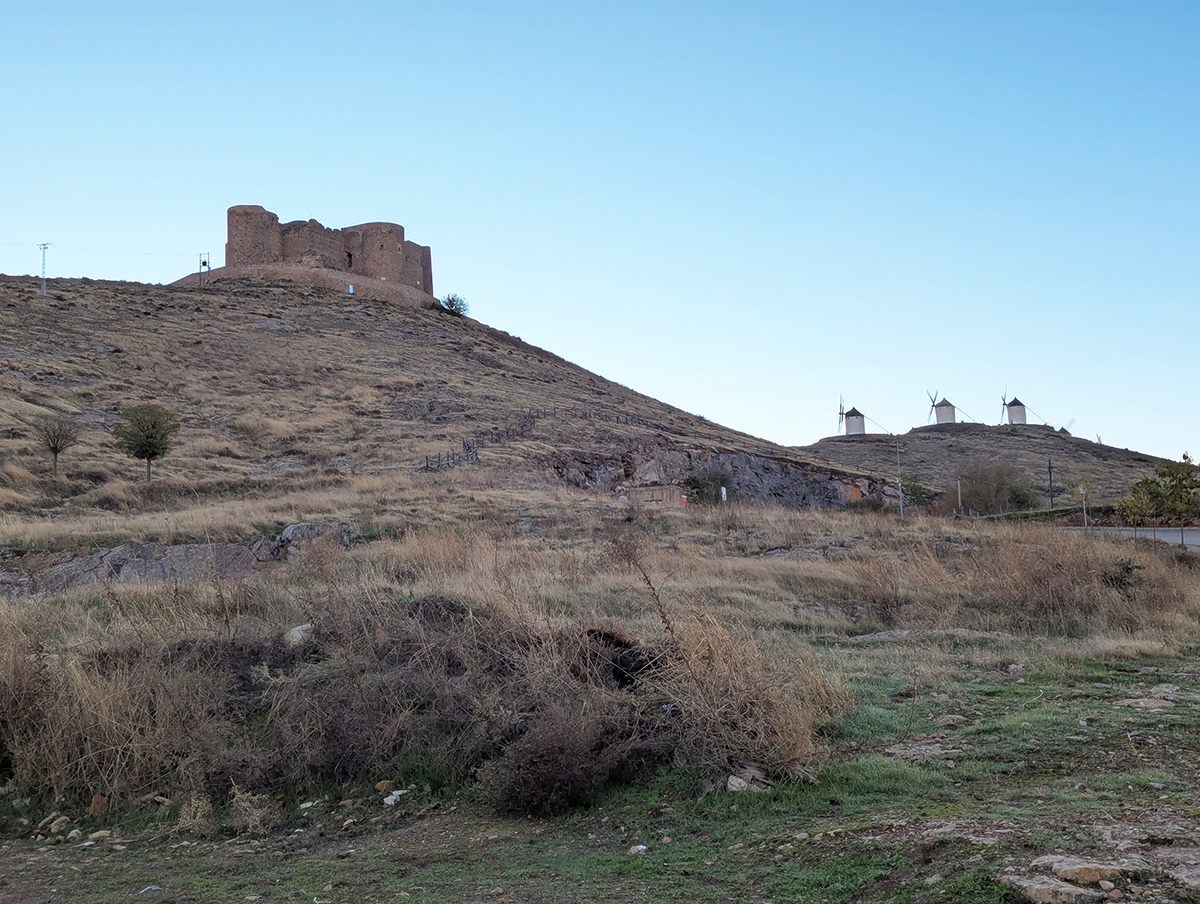
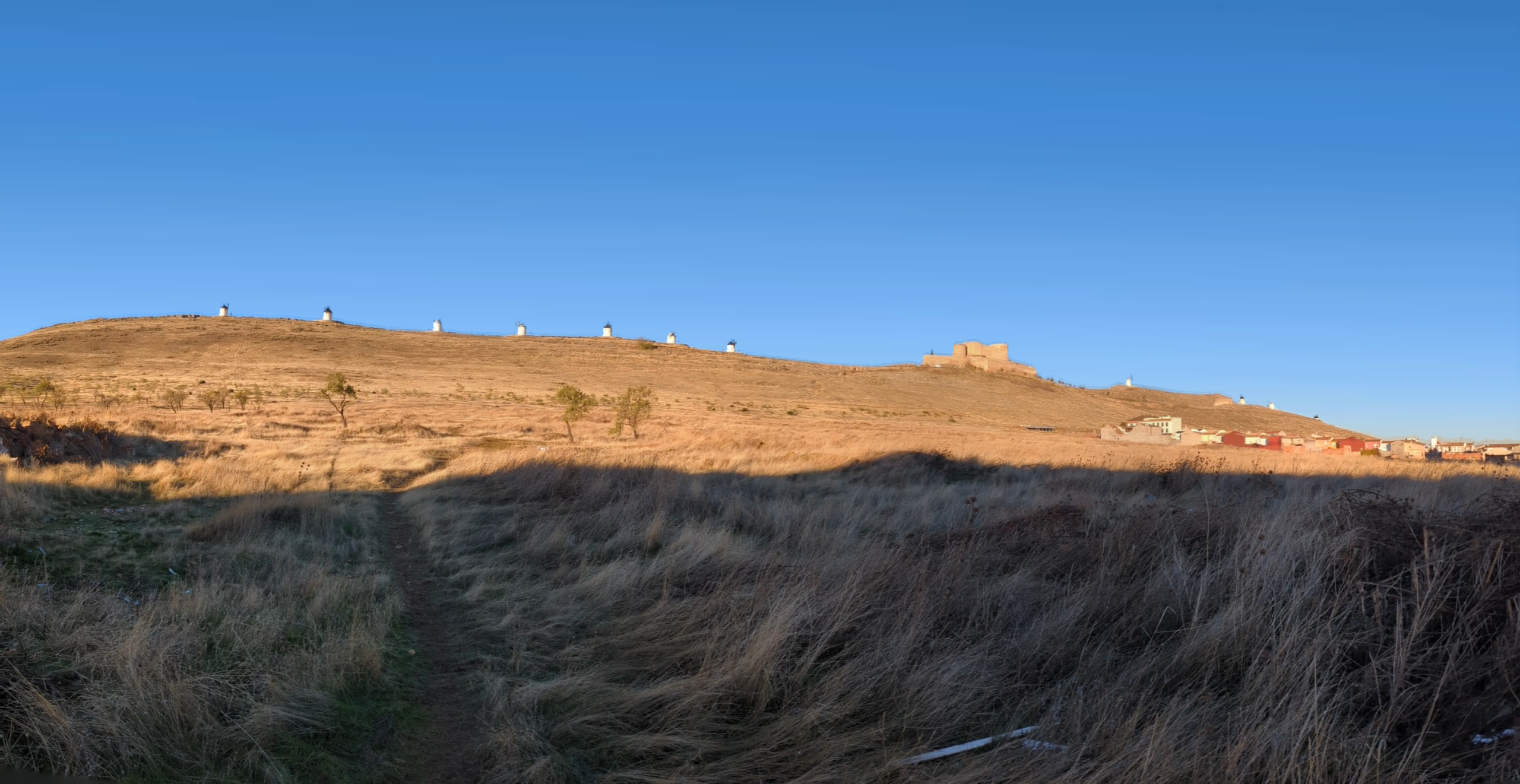
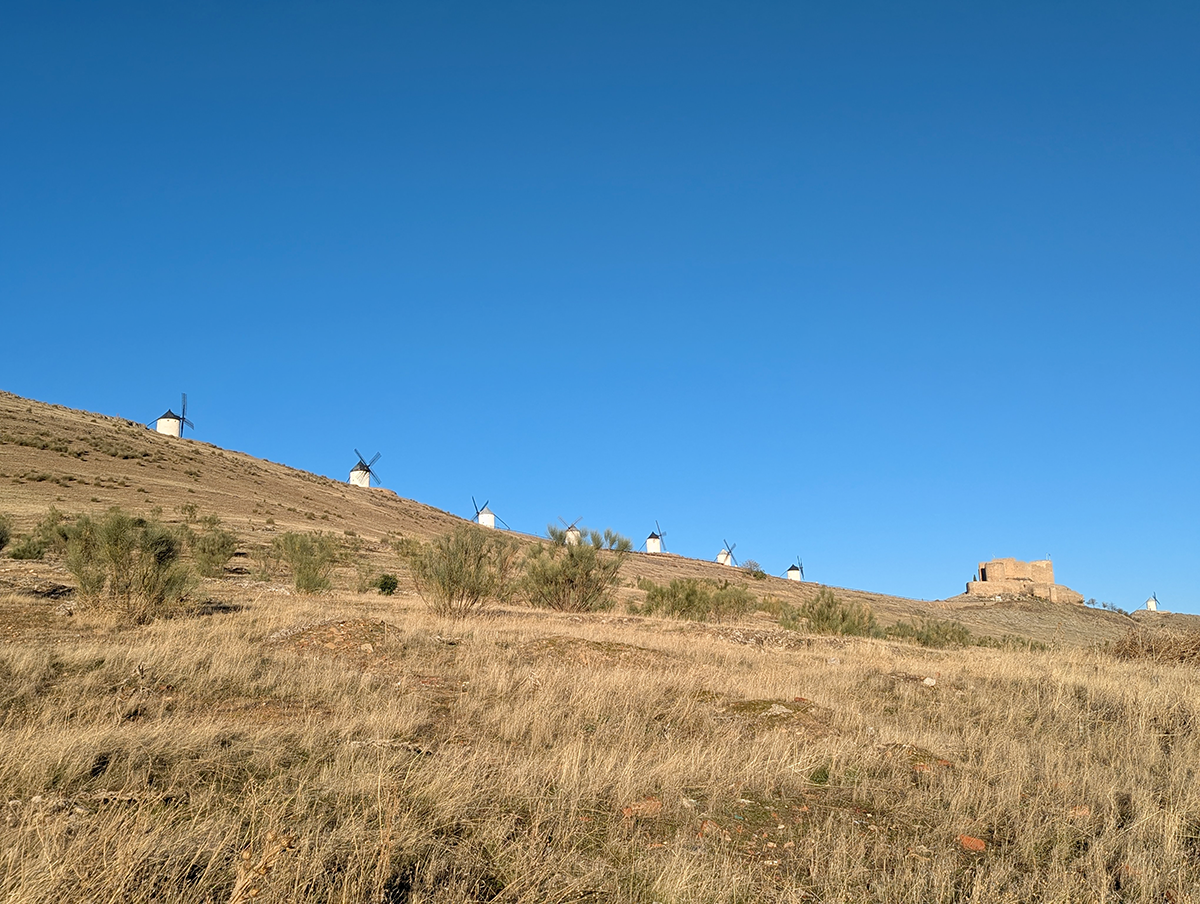
I planned my Consuegra running route so I could see the windmills from every possible angle. The first mile was a long uphill that took me from our AirBNB to the top crest of the Cerro Calderico. I timed it so I’d get up there just as the sun was coming up. The views were spectacular!
Once I hit the crest, I followed a trail north along the east flank of the ridge. At this point, I called Marion and we took pictures of each other—me from one of the mills, her from our rooftop terrace. From there, I circled the ridge again and further out into the countryside. I ran through vineyards and groves of olive and almond trees, and past pens filled with bleating sheep.
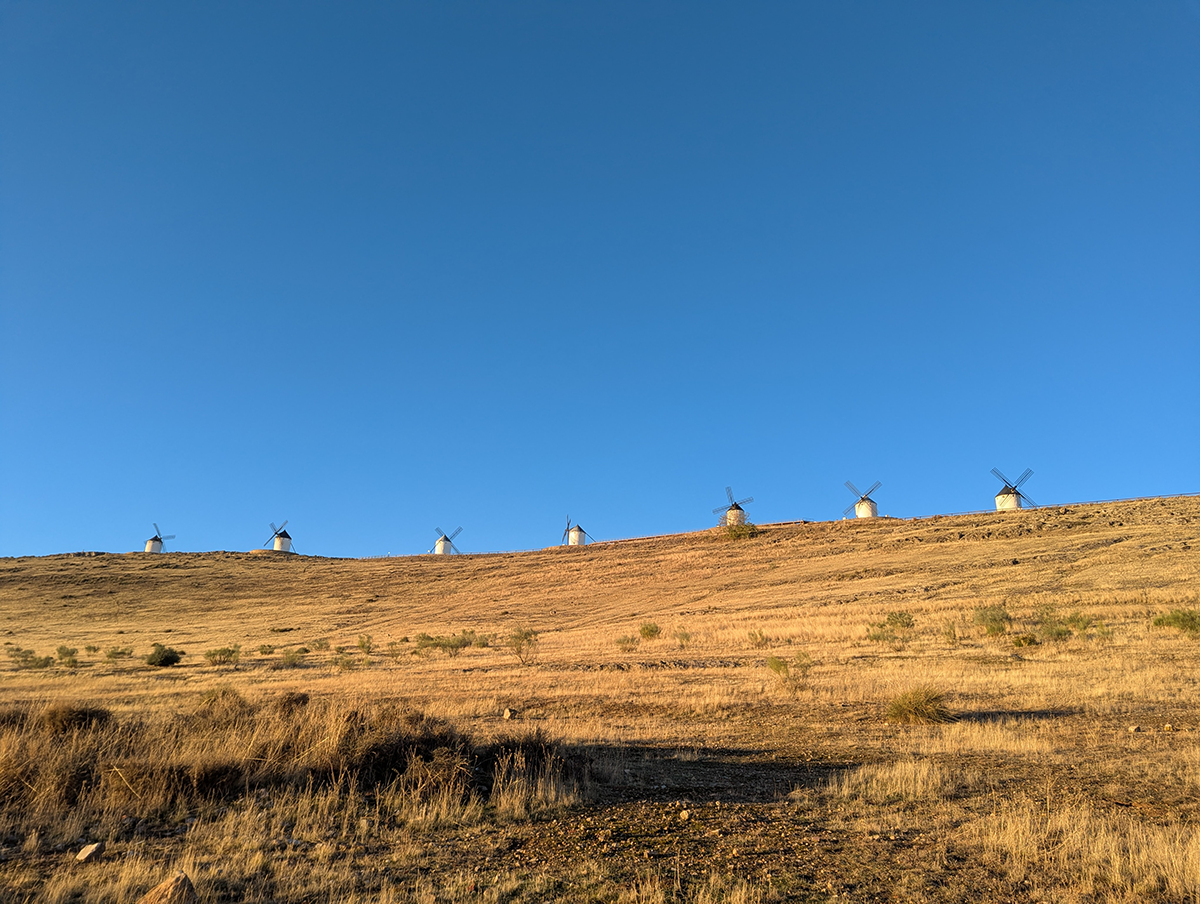
I looped around the south end of the ridge and completed my circle on the west side, getting yet another view of the windmills and castle. A little jaunt through town and I was back where I started. I ended up running just over 7 miles, with 560 feet of vertical gain.
The Windmills of Consuegra
According to the tourist info, Consuegra’s windmills are some of the largest, best-preserved traditional Manchegan mills in Spain. Lined up on the spine of the Cerro Calderico, with a castle in the middle, they serve as a symbol of La Mancha’s grain-growing history and literary identity.
Some of the current mills incorporate structures or machinery dating back to the 16th century, while others are later reconstructions in the traditional style. The towers have three interior levels: lower floors used for storage of grain and flour, and an upper floor housing the wooden gears and millstones driven by the sails. The machinery, made of oak and other local woods, was refined over generations so millers could point the cap into the wind, adjust sailcloths, and regulate the grind. That’s the way they did it for centuries.
The mills were gradually retired, though a few were still apparently in use as late as the 1980s. After a period of neglect, the town began restoring them. Twelve mills were recovered or rebuilt, and the entire group (together with the castle) is now recognized as an important stop on the Don Quixote tourist route.
Castillo de Consuegra
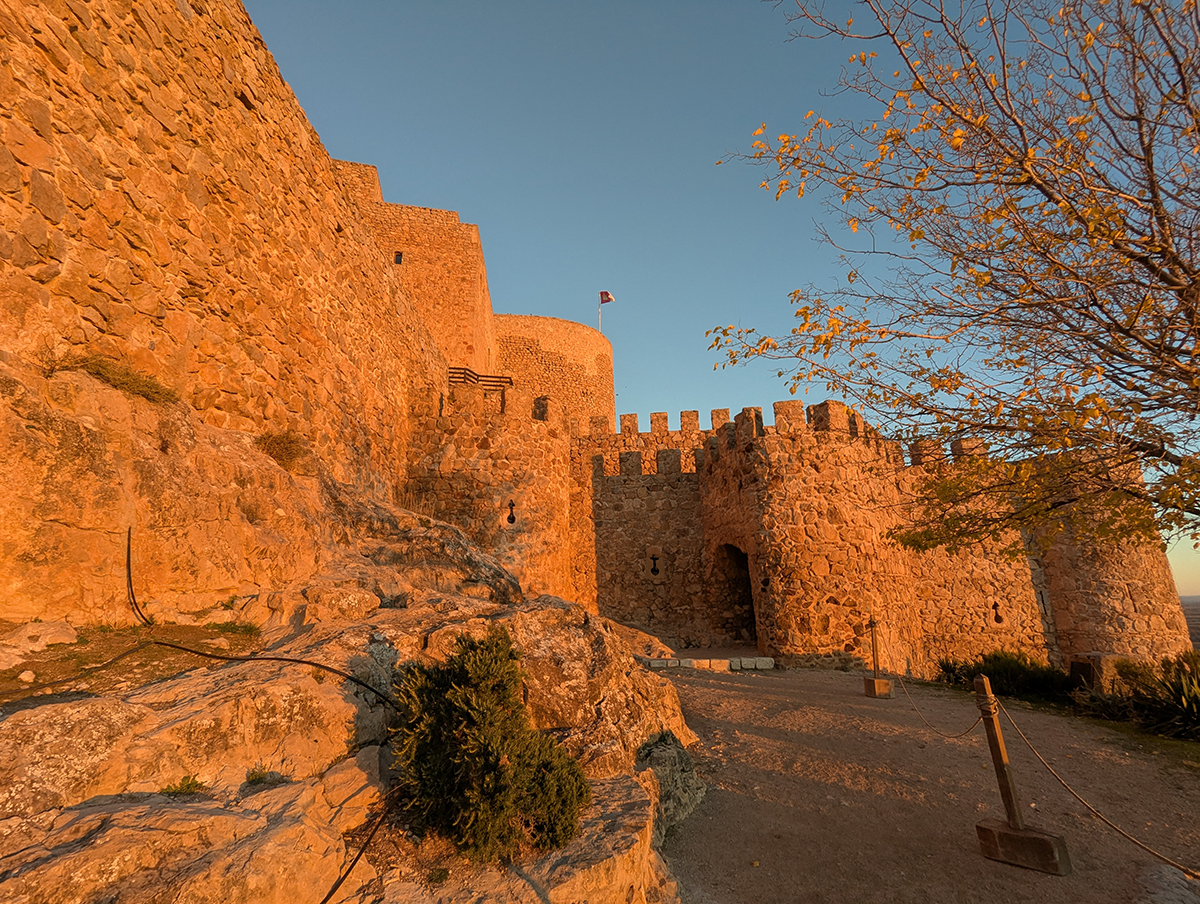
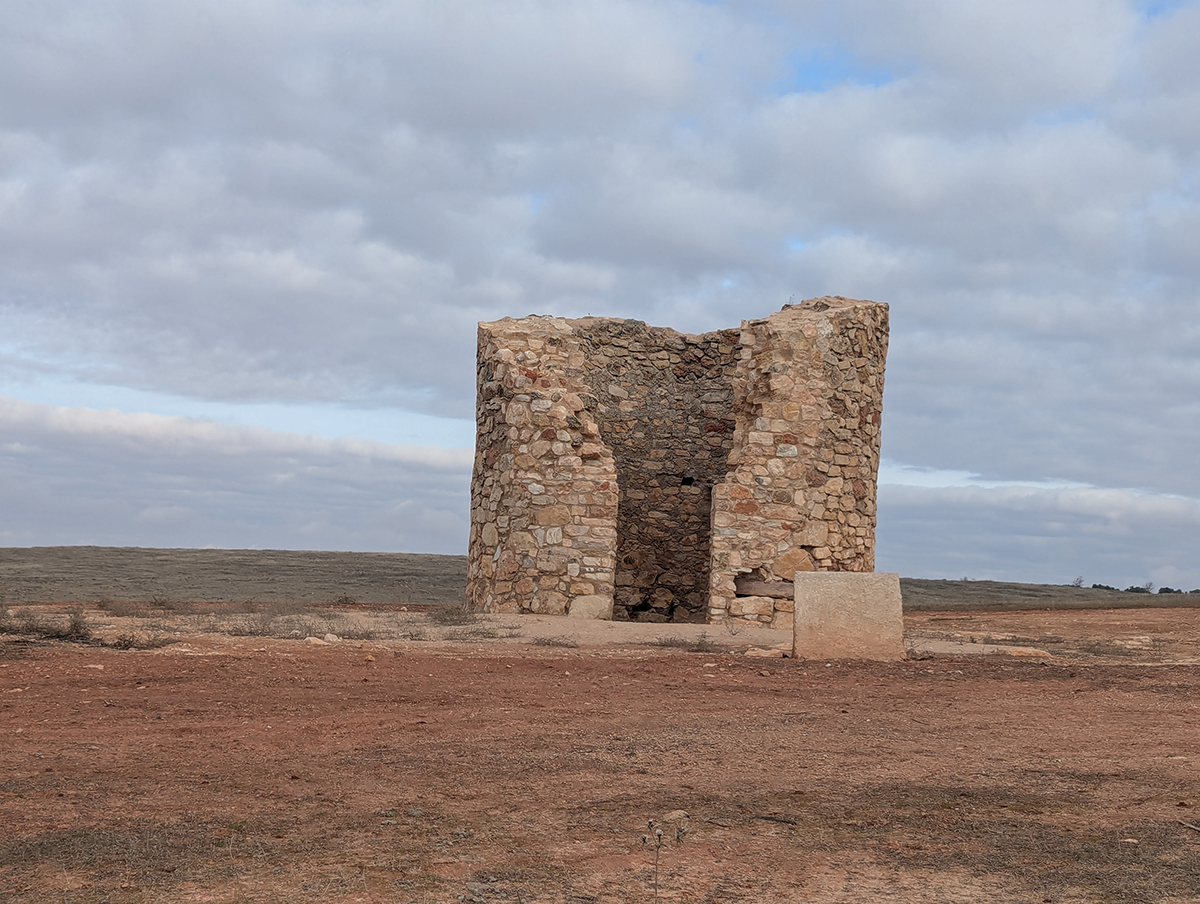
After breakfast, Marion and I went back up the hill to explore some more. One of the mills contained a little gift shop, and we bought a magnet from a very insistent shopkeeper. At another one, we paid a few Euros to get access to the upper levels, where the machinery is still in place (or possibly restored?). Walking further up the hill, we took photos through a section of crumbling wall, then paid another couple of Euros to tour the castle.
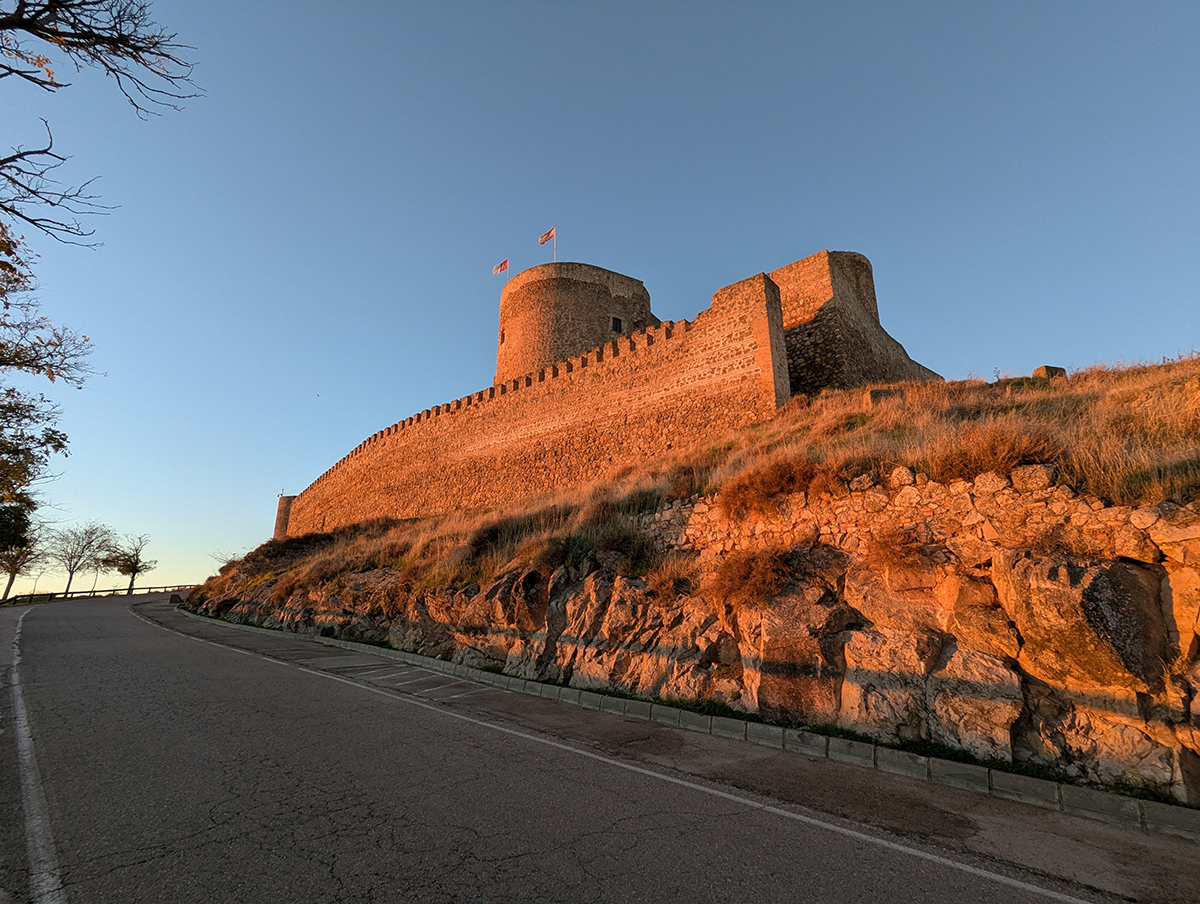
Castillo de Consuegra is a hilltop fortress that began as a 10th-century Moorish watchtower during the Córdoba Caliphate. After changing hands in the Christian reconquest, the expanded castle was taken by King Alfonso VIII and in 1183 was granted to the Knights of Saint John of Jerusalem, who rebuilt and enlarged it. The castle saw its peak between the 13th and 15th centuries, changed hands during the power struggles of the 17th century and suffered serious damage in the Peninsular War. It eventually fell into decline, becoming municipal property in the 20th century. Since the 1960s it has been extensively restored, allowing visitors today to explore features such as cisterns, dungeons, a chapel, archive rooms, and ramparts overlooking the famous windmills.
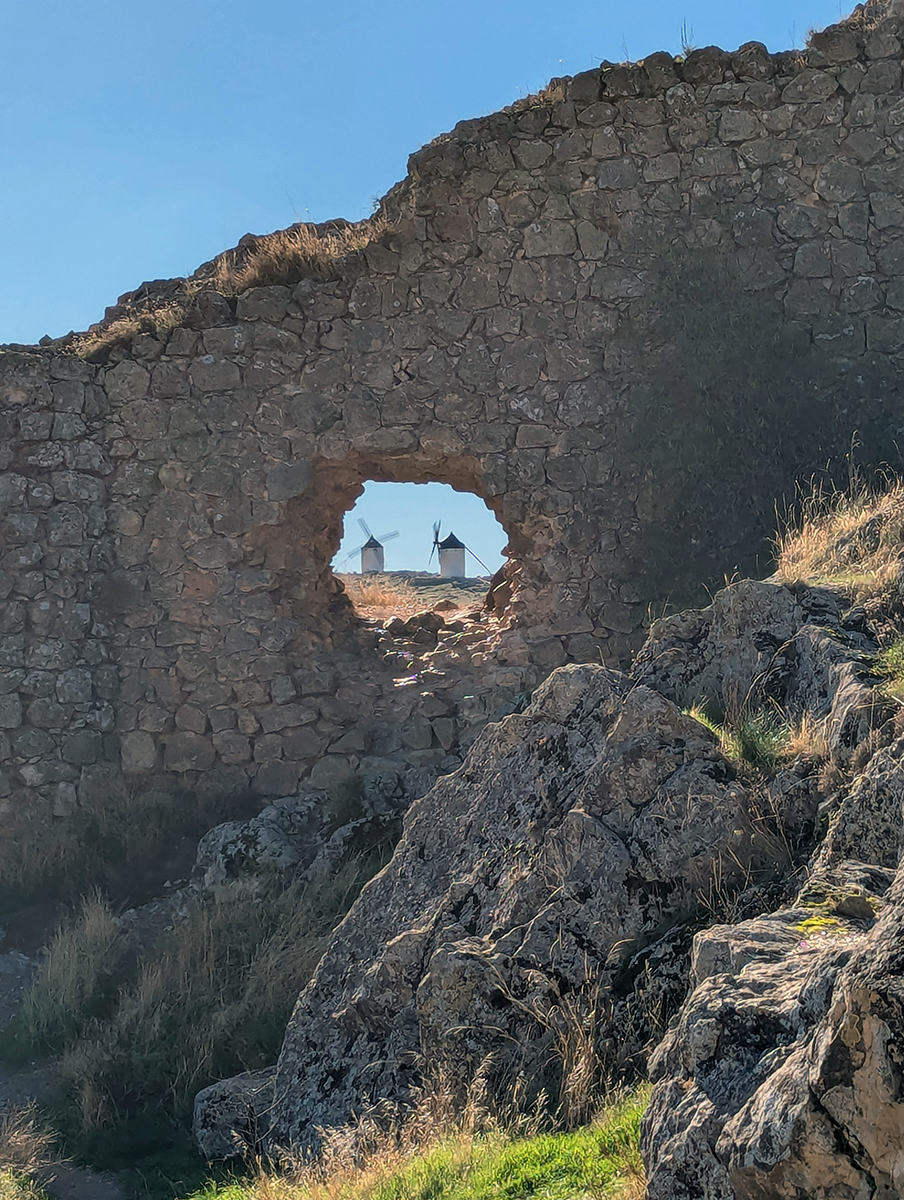
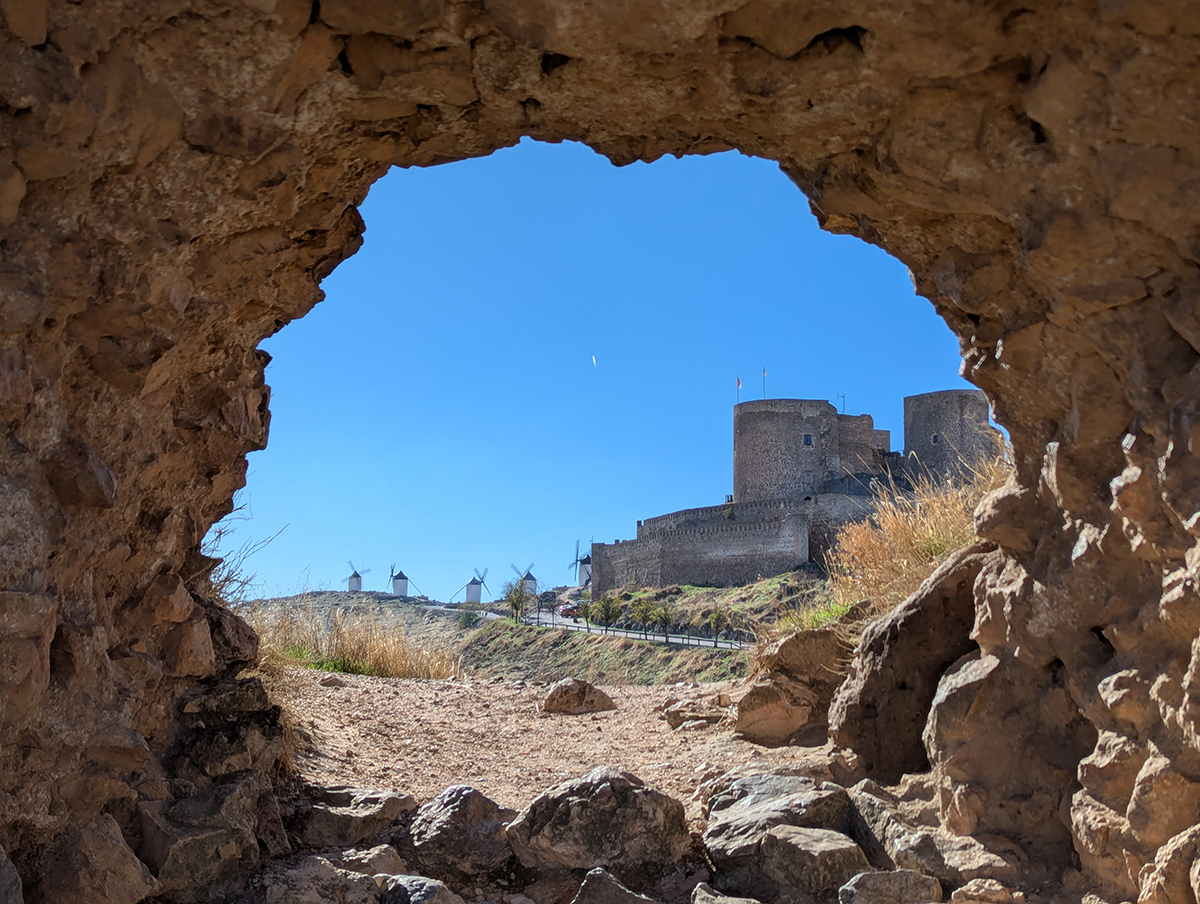
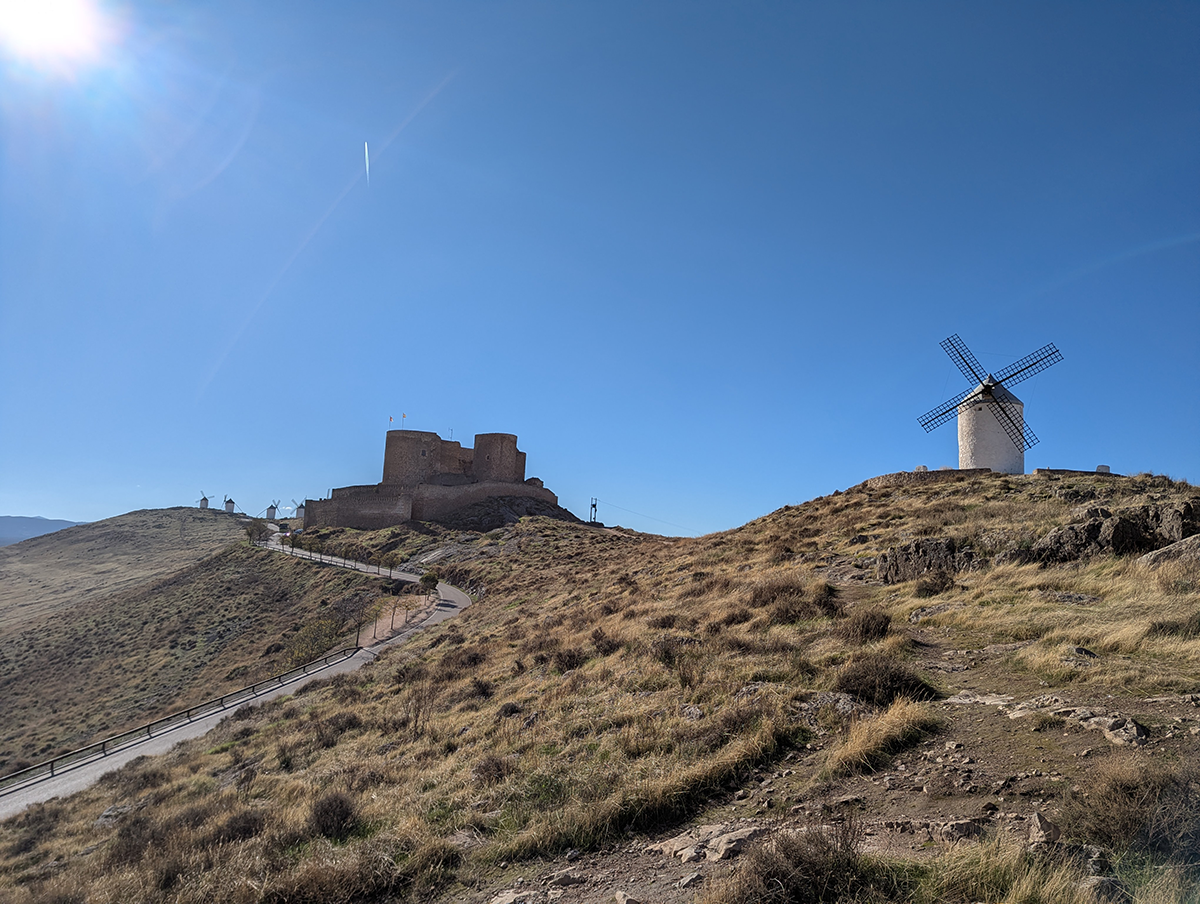
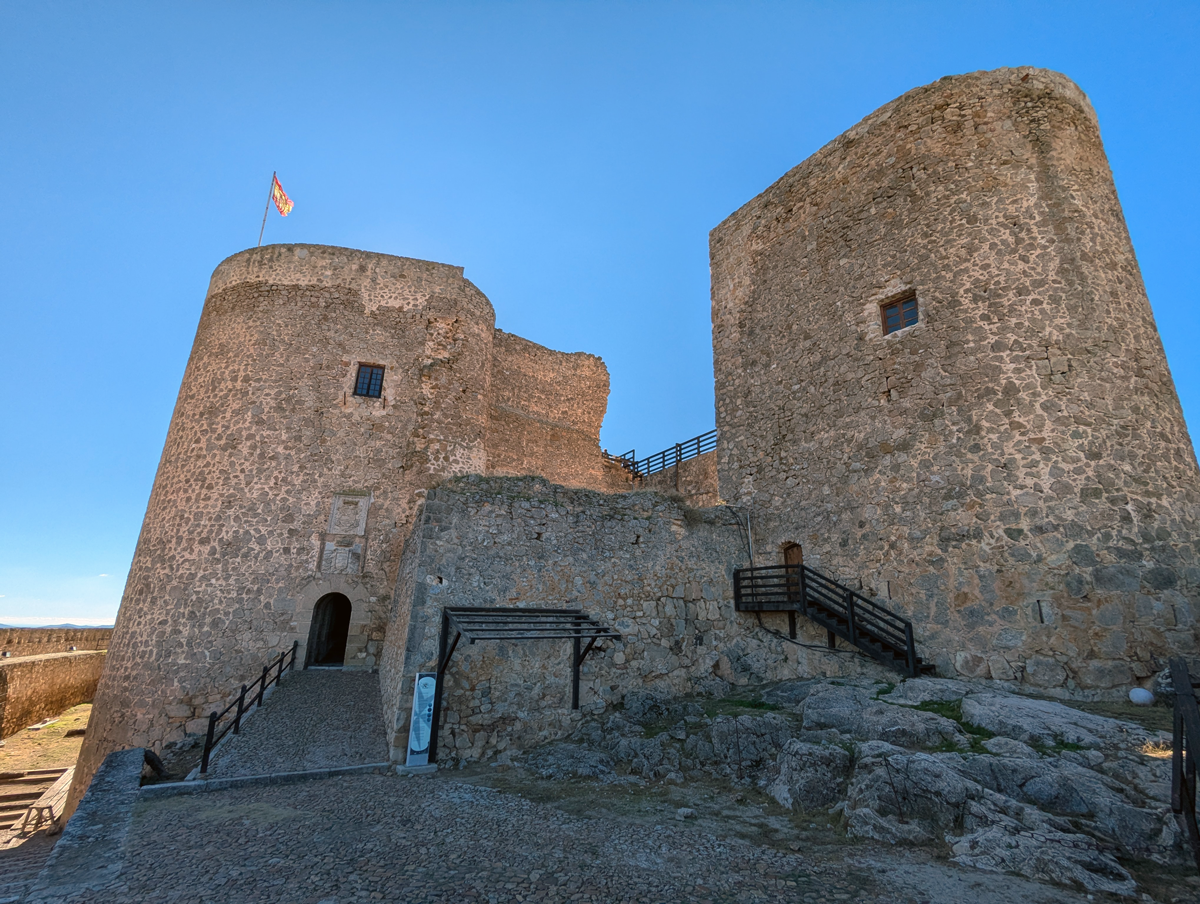
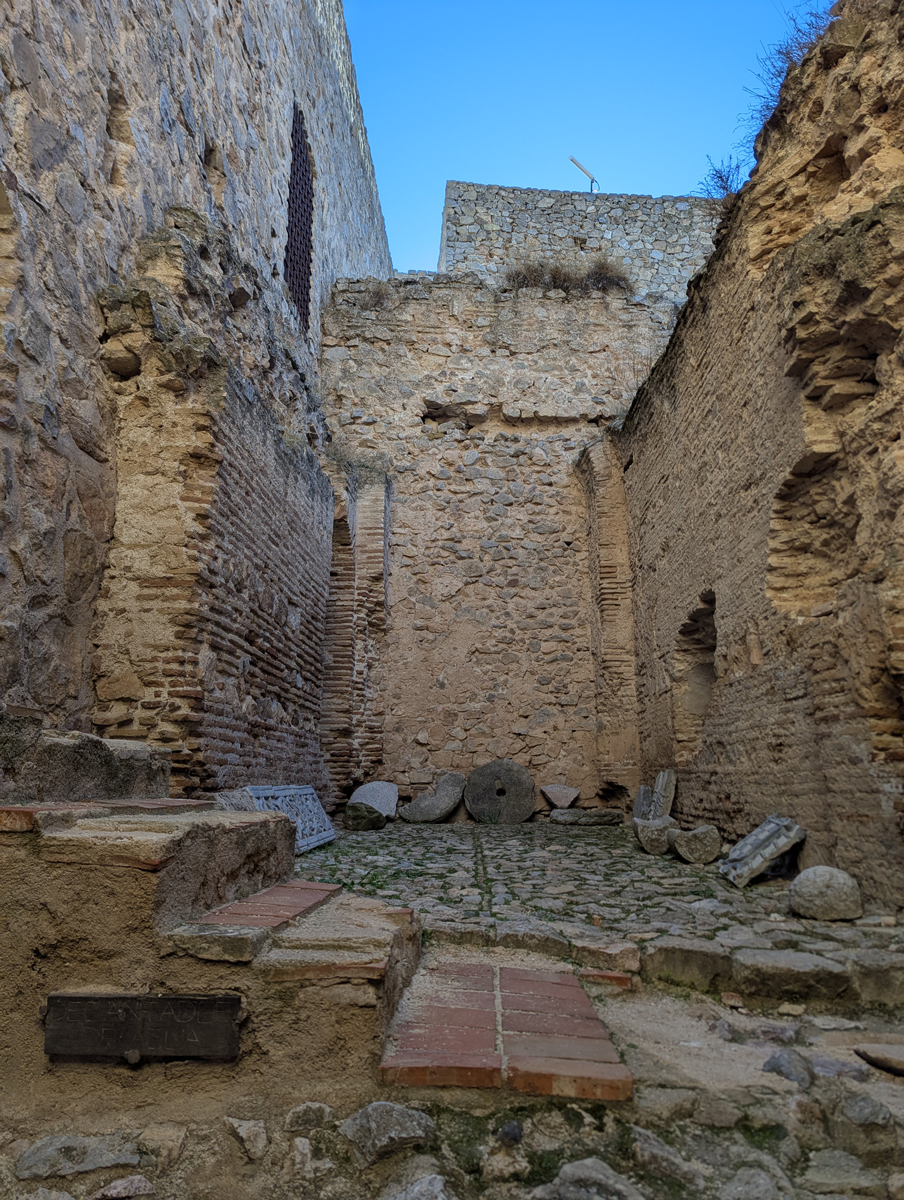
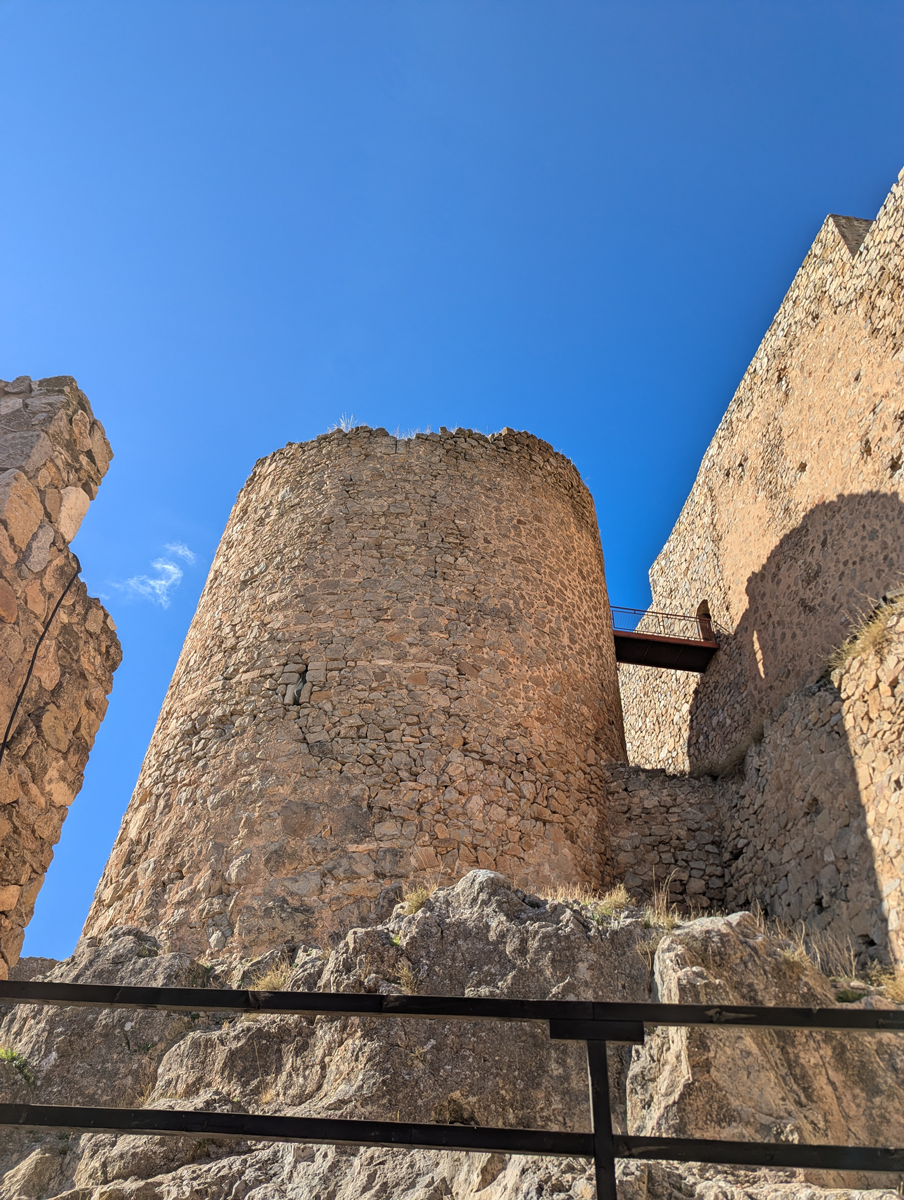
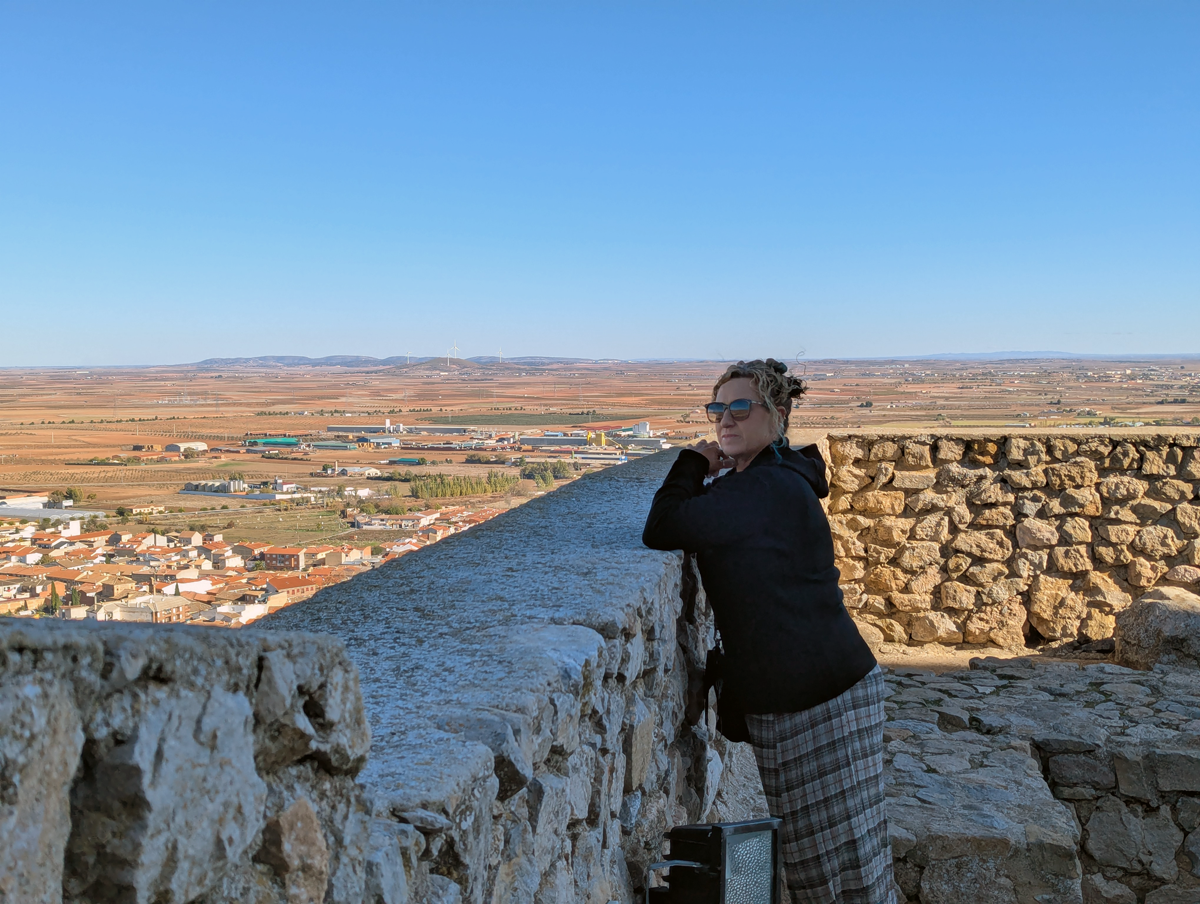
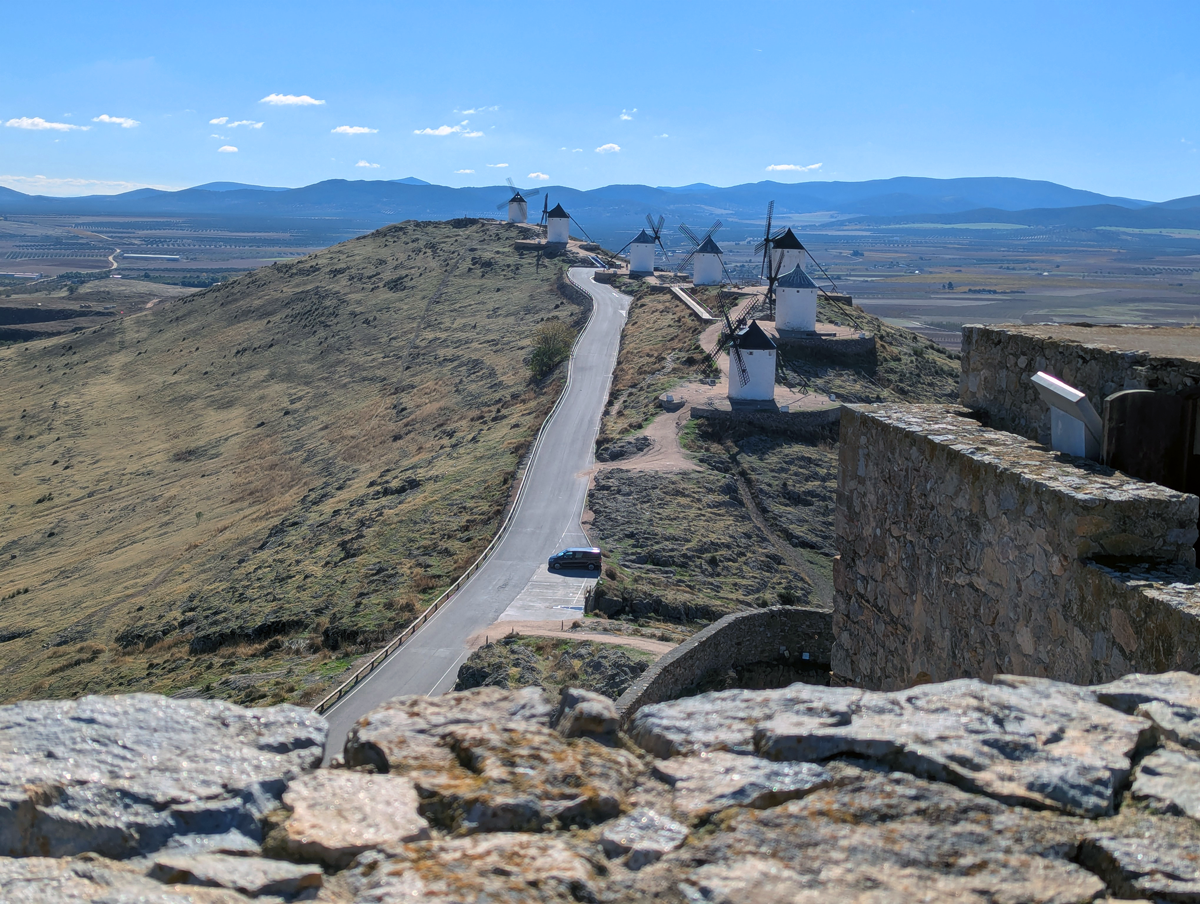
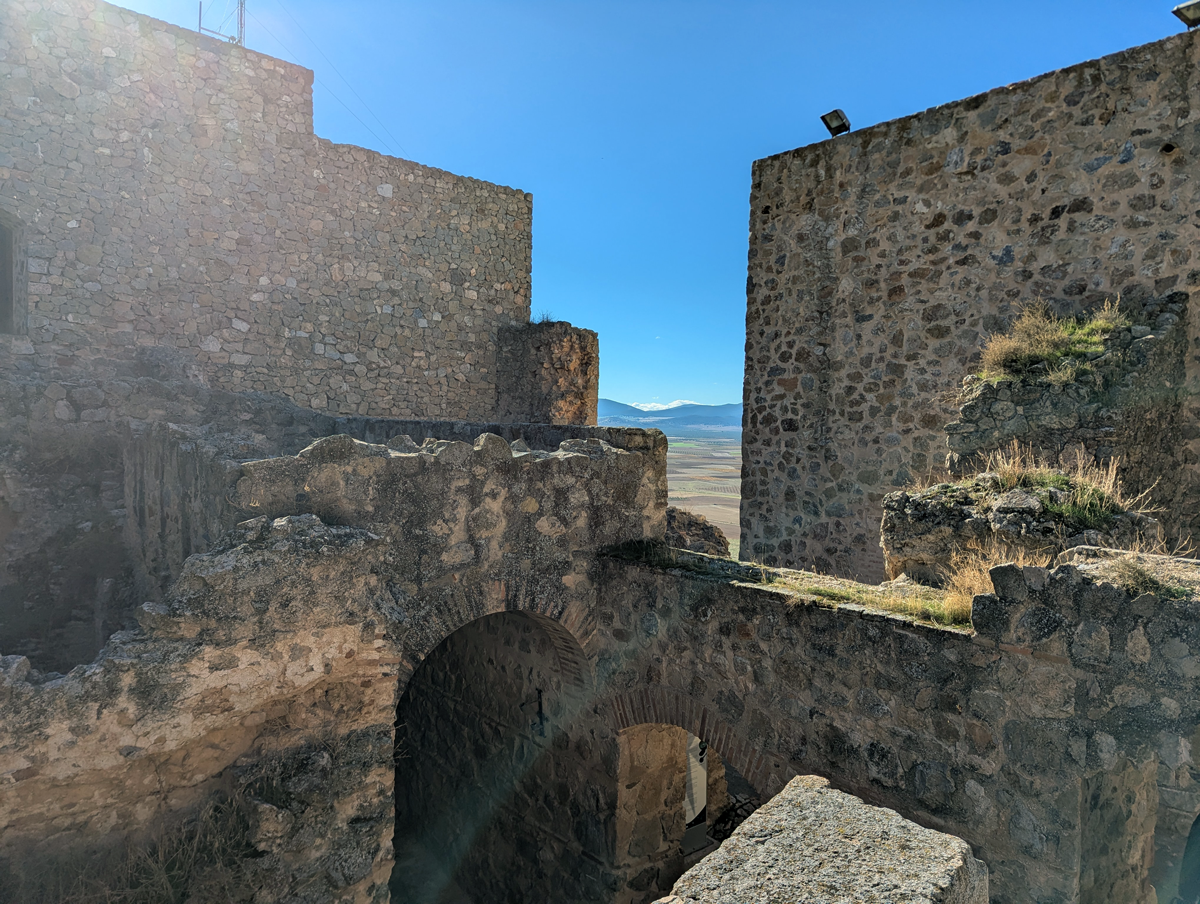
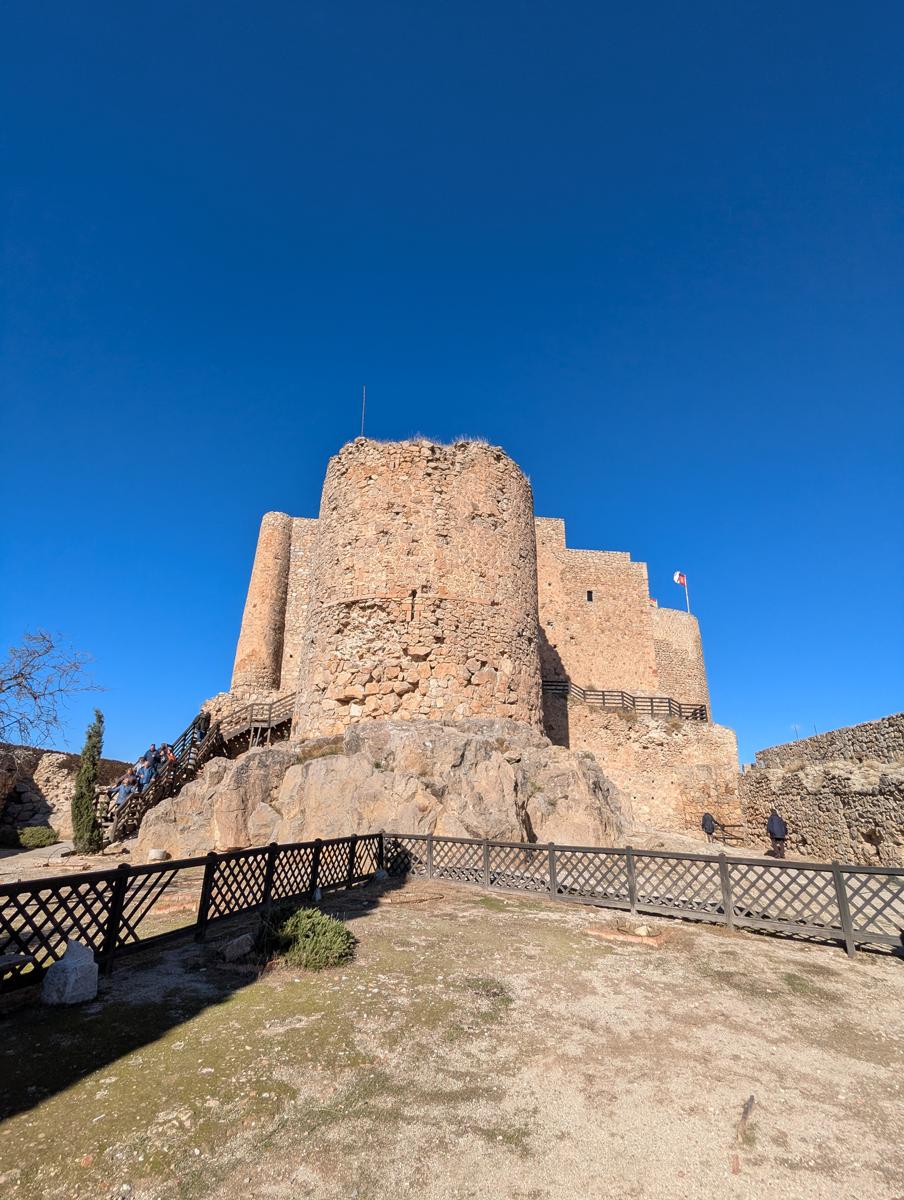
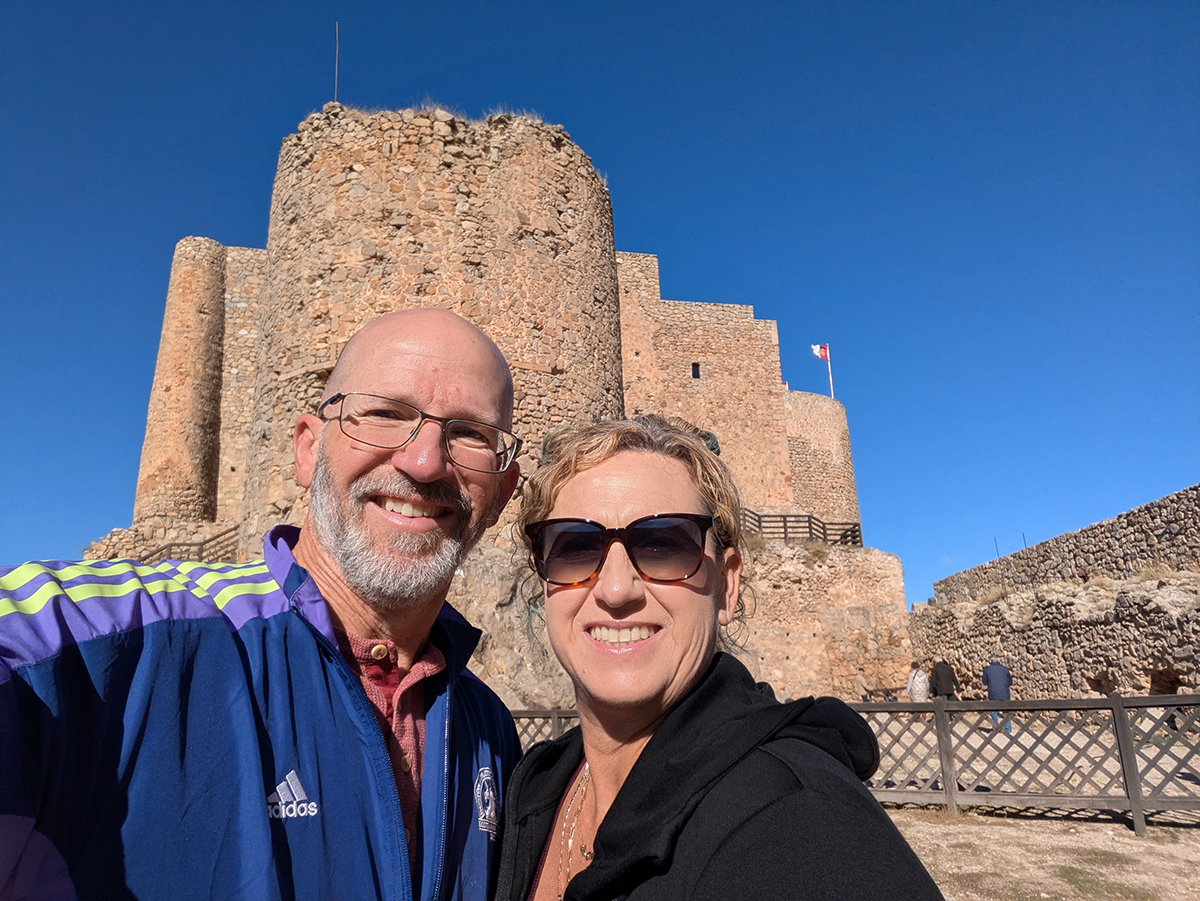
We had a great time touring the castle and enjoying the views. It’s amazing how much history Spain can pack into a single half-mile ridgeline.
A Visit to Campo de Criptana
The next day, on our way to Cuenca, we decided to visit another set of windmills in the town of Campo de Criptana. Now, the proud folks of Consuegra swear that their windmills are Don Quixote’s. Not surprisingly, the people of Campo de Criptana swear the same thing. Both Consuegra and Campo de Criptana sit squarely in La Mancha, where Cervantes set Don Quixote’s adventures, and though both claims to be home to the famous windmills, the evidence for either is mostly circumstantial, relying on local tradition rather than hard proof.
The Case for Consuegra
The 12 “molinas de ventanas” in Consuegra are a good visual match the idea of giants “marching” along a hilltop. Historians describe them as among the best-preserved (or best-restored) and most iconic La Mancha mills. Local interpretation panels explicitly identify them as the giants Don Quixote attacked, with each mill given a name from the novel.
The line of mills on a single, narrow ridge above open plains closely fits how many readers visualize the scene, and this view has strongly influenced popular and tourist imagination. Though Consuegra’s mills are widely promoted in tourism guides as “Don Quixote’s windmills,” there’s no documentary proof that this exact group inspired Cervantes when he wrote.
The Case for Campo de Criptana
Campo de Criptana’s mills, situated on a rise above the town, aren’t nearly as picturesque as the ones in Consuegra, but some surviving examples provably date back to the 16th century, which would put them in Cervantes’s lifetime. The town’s location in La Mancha matches the kind of grain-growing, windy plateau evoked in the novel. Like the Consuegra mills, these have also been restored to foster tourism, so what visitors see today is partly a modern reconstruction.
Final Verdict
Ultimately, there’s no way to know which windmills are the windmills. Cervantes gives no precise locations for his windmill chapter, so any town’s claim is as good as another’s. From a historical and literary perspective, many scholars assume Don Quixote’s windmills as a composite of those that dotted several La Mancha towns—Consuegra, Campo de Criptana, Alcázar de San Juan, and others—rather than a portrait of a single, identifiable hill.
If forced to weigh the rival arguments, I’d say Consuegra has the stronger claim. With twelve mills and a castle, the Cerro Calderico feels quintessentially “La Manchan.” For a reader trying to imagine the scene, both towns offer credible landscapes. Taken together with other La Mancha mill sites, they probably give a better sense of Cervantes’s inspiration than either place alone.
The Don Quixote Route
Someday I’d love to follow the entire Don Quixote route, a 328-mile trek that visits all the locations (or claimed locations) that helped inspire one of the greatest works of fiction in any language.
As someone who writes novels, I wanted to see the windmills for myself. As someone who loves music (and musical theater), I also wanted to see the inspiration for some of the most wonderful music ever written. Because what else was I going to do in Spain?